
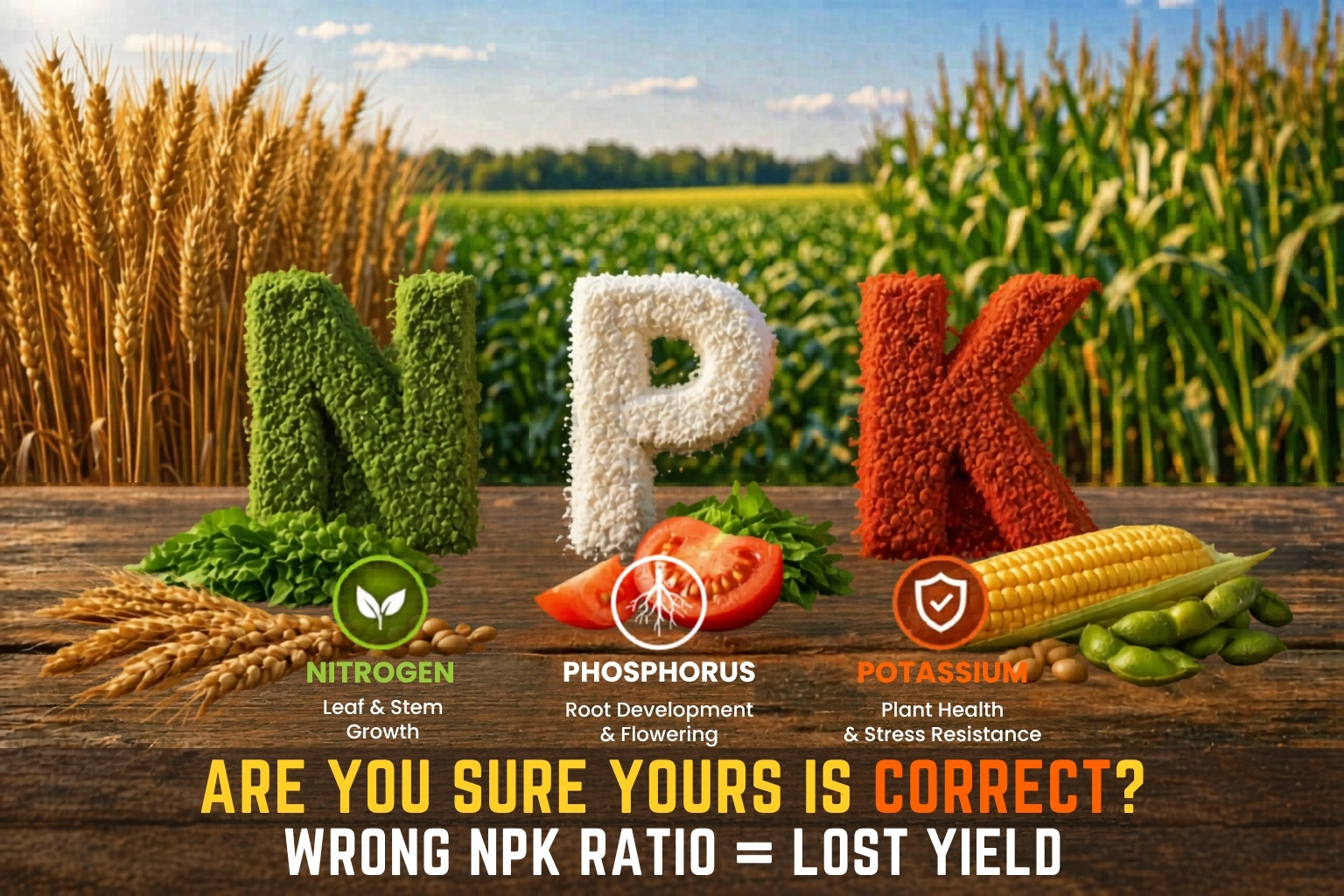
A wheat program that performs well in one region can underdeliver in another with the same total fertilizer rate. The difference is often not the amount of nutrition applied, but the balance. Crop specific npk ratios matter because nitrogen, phosphorus, and potassium do not drive the same result in every crop, every soil, or every growth stage.
For commercial growers and professional buyers, this is not an academic detail. The right ratio influences canopy development, root strength, flowering, fruit set, filling, stress tolerance, shelf life, and nutrient use efficiency. The wrong ratio can push vegetative growth when the crop needs reproductive support, tie up capital in wasted inputs, or limit yield even when overall fertilizer volume looks adequate.
Why crop specific NPK ratios matter
NPK is often discussed as a basic formula, but performance comes from proportion, timing, and fit. A leafy vegetable with aggressive biomass production usually responds to a program with stronger nitrogen support. A fruiting crop typically needs a different balance as it moves from vegetative growth into flowering and fruit enlargement. Root and tuber crops can suffer if nitrogen is pushed too hard at the expense of phosphorus or potassium.
That is why crop specific NPK ratios should be selected around crop physiology, not just product availability. In practical terms, the ratio needs to match what the crop is trying to build. Leaves, roots, flowers, grains, fruits, and storage organs all place different demands on the plant.
There is also a financial angle. Better ratio alignment improves nutrient efficiency, which helps reduce losses from leaching, fixation, and excess vegetative growth. In large-scale production, even modest gains in efficiency can make a meaningful difference to total input cost per ton harvested.
The agronomic logic behind ratio selection
Nitrogen mainly drives vegetative growth, chlorophyll formation, and protein synthesis. It is essential for canopy expansion and yield potential, but excess nitrogen can delay maturity, reduce structural strength, and weaken quality in some crops. In cereals, too much nitrogen can increase lodging risk. In fruiting crops, it can produce foliage at the expense of fruit set and uniformity.
Phosphorus is closely tied to root development, early establishment, energy transfer, and reproductive processes. It is especially important in early growth stages, cool soils, and crops that need strong establishment before rapid biomass accumulation. A weak phosphorus program often shows up as slow start, uneven vigor, and reduced reproductive efficiency later.
Potassium is strongly linked to water regulation, enzyme activation, transport of sugars, crop firmness, stress response, and quality attributes. In high-yielding systems, potassium often becomes a deciding factor in fruit size, color, dry matter, grain filling, and post-harvest performance. Crops with high removal rates or high quality requirements usually need stronger potassium emphasis than standard programs provide.
The trade-off is straightforward. More nitrogen can accelerate growth, but if phosphorus and potassium do not keep pace, the crop may become imbalanced. More potassium can improve quality and stress tolerance, but if nitrogen is too low early, biomass and yield potential may never fully develop. The right answer depends on the crop target and the production environment.
Crop specific NPK ratios by crop category
There is no single universal ratio for all fields, but crop groups do show clear nutritional patterns.
Cereals and grain crops
Cereals such as wheat, corn, rice, and barley usually require a nitrogen-led program because yield is closely tied to biomass and grain formation. Even so, phosphorus is critical during establishment and early root growth, while potassium supports water management, stalk strength, and grain fill.
A balanced ratio such as 20-10-10 or 24-8-16 can fit early to mid-season cereal demand in many systems, especially where soils already carry moderate phosphorus and potassium reserves. In low-phosphorus soils or under cool planting conditions, a more phosphorus-supportive starter can improve stand establishment. In high-yield corn, potassium demand can become more significant than many standard blends assume, particularly on lighter soils or in fields with high removal history.
Leafy vegetables
Leafy crops such as lettuce, spinach, cabbage, and similar vegetables typically favor higher nitrogen support during active vegetative growth. The objective is rapid leaf area development, strong color, and uniform canopy production. Ratios such as 20-10-10 or 30-10-10 are often aligned with this stage when soil test phosphorus and potassium are adequate.
That said, excessive nitrogen can reduce tissue strength, shorten shelf life, and increase susceptibility to certain disorders. In commercial supply chains, marketability matters as much as fresh weight. Potassium should not be overlooked where firmness, transport tolerance, and post-harvest quality are priorities.
Fruiting vegetables
Tomato, pepper, cucumber, eggplant, and similar crops need a changing ratio as they move through growth stages. Early growth benefits from balanced nutrition with enough nitrogen to build a healthy canopy and enough phosphorus to strengthen root activity. Once flowering and fruiting intensify, potassium becomes more important.
This is why many professional programs shift from a balanced formula toward ratios such as 15-5-30 or 12-6-24 during fruit development. The higher potassium share supports fruit size, color, sugar movement, firmness, and stress management. If nitrogen remains too dominant late in the cycle, the crop may continue vegetative growth when fruit load should be the main priority.
Root and tuber crops
Potato, carrot, onion, sugar beet, and other storage-organ crops generally require careful nitrogen control. Too much nitrogen can increase foliage while limiting bulking efficiency, maturity, or storage quality. Phosphorus helps early establishment, and potassium is often central to size, dry matter, skin quality, and storage performance.
In these crops, balanced to potassium-forward ratios are often more effective than strongly nitrogen-heavy formulas. Programs such as 15-15-15 may work early where soils are variable, while later-stage nutrition may move toward stronger potassium support. The exact ratio depends heavily on expected yield, irrigation, and the crop quality standard demanded by the market.
Fruit trees and vineyards
Perennial crops add another layer because nutrition affects both the current crop and the next cycle. Nitrogen supports shoot growth and leaf function, but too much can reduce fruit quality and create management issues. Potassium often plays a major role in fruit fill, sugar accumulation, coloration, and firmness.
For orchards and vineyards, the right ratio usually changes with phenological stage rather than staying fixed all season. A balanced approach may suit early growth, while reproductive stages often justify more potassium emphasis. Excess phosphorus is not always beneficial if root-zone reserves are already sufficient, so ratio decisions should be tied closely to soil and leaf analysis.
Why one ratio is not enough for the full season
Many procurement teams still ask for the best ratio for a crop as if there were a single answer. In reality, crop specific NPK ratios are often stage specific. Establishment, vegetative growth, flowering, fruit set, filling, and maturity all shift nutrient priorities.
A starter formula with stronger phosphorus can improve emergence and root activity. Mid-season nitrogen may build yield potential. Late potassium support can improve quality and marketable output. Keeping the same ratio all season may simplify purchasing, but it rarely maximizes performance.
This is where formulation flexibility matters. Water-soluble NPKs, liquid fertilizers, and specialty blends allow programs to be adjusted as crop demand changes. For distributors and commercial growers, that flexibility supports better agronomic fit without overcomplicating operations.
Soil, water, and climate still change the answer
Even the best crop-based ratio can fail if field conditions are ignored. Soil pH affects phosphorus availability. Sandy soils often increase potassium and nitrogen loss risk. High-yield irrigated systems remove nutrients differently than lower-intensity rainfed production. Salinity, temperature, and water quality also influence how efficiently the crop can take up what is applied.
That is why ratio decisions should be grounded in soil analysis, crop removal targets, irrigation strategy, and local stress conditions. A tomato crop in protected production with fertigation may justify a very different ratio strategy than an open-field processing tomato crop. The crop category is the starting point, not the full prescription.
What professional buyers should look for in NPK supply
For commercial agriculture, performance depends not only on ratio design but also on manufacturing consistency. A strong formula on paper loses value if solubility is poor, raw material quality varies, or nutrient content is inconsistent across shipments.
Professional buyers should look for suppliers that can support multiple crop and stage requirements with dependable formulation quality, stable sourcing, and scalable supply. That is particularly important for distributors, wholesalers, and agronomy-led procurement teams serving diverse crop portfolios across different regions. A producer with in-house manufacturing capability can usually offer better control over formulation quality, batch consistency, and long-term supply planning than a business built only around trading.
At FERTIZER, this production-driven approach supports crop nutrition programs that are designed for field performance as well as supply reliability.
The better question is not which NPK ratio is best. It is which ratio is best for this crop, in this soil, at this stage, under this yield target. When that question is answered well, fertilizer becomes more than an input line. It becomes a measurable driver of crop performance.