
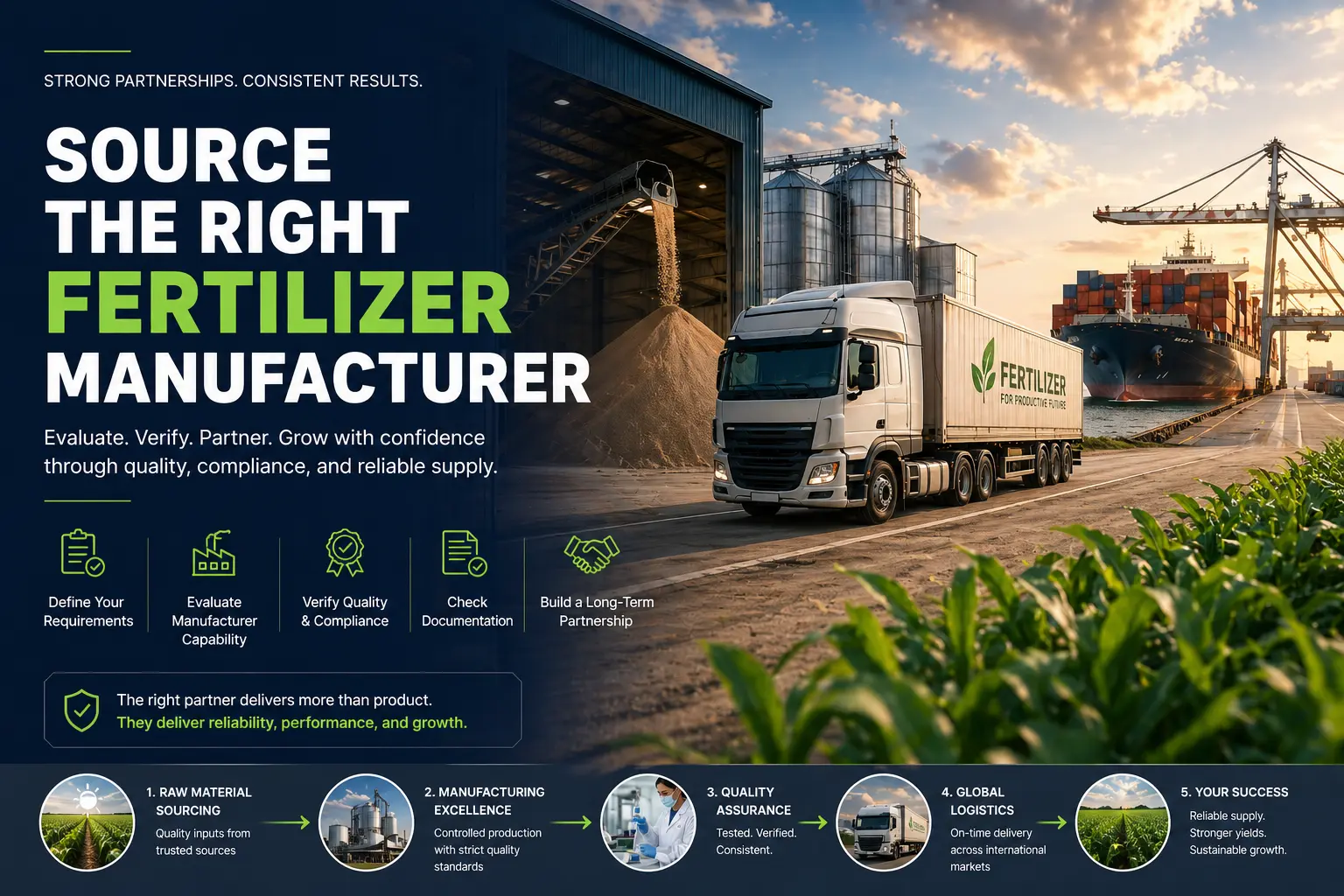
Sourcing a fertilizer manufacturer is the process of selecting a production partner based on production capability, raw material sourcing, quality control systems, compliance readiness, and long-term supply reliability. The right supplier is not the cheapest one, but the one that can consistently deliver technically suitable products at scale and on time.
A fertilizer supply problem rarely starts at the port. It usually starts much earlier – with the wrong manufacturing partner. If you are evaluating how to source fertilizer manufacturer relationships that can support real commercial growth, the key is not just finding a supplier with inventory. It is finding a producer that can deliver consistent product quality, technical fit, regulatory discipline, and stable supply across seasons.
For importers, distributors, wholesalers, and private label buyers, that distinction matters. A low quote can look attractive on paper, but inconsistent nutrient content, delayed production, poor packaging, or weak documentation will cost far more once the product reaches your market.
Sourcing well means looking beyond price and assessing whether the manufacturer can perform under pressure, at scale, and over time. As also highlighted in global fertilizer supply guidelines by organizations such as the FAO and the World Bank, supply chain issues in fertilizers are more often linked to documentation, quality consistency, and logistics alignment than to production defects alone.
How do you source a reliable fertilizer manufacturer?
The first step is defining what you actually need to buy. That sounds obvious, but many buyers start conversations with a broad request such as NPK fertilizer, organic fertilizer, or micronutrients without setting technical and commercial parameters. A manufacturer cannot be evaluated properly unless your product brief is clear.
- Product category (e.g. NPK, liquid, organomineral, micronutrients)
- Formulation and nutrient ratios
- Target crops and application method (foliar, fertigation, soil)
- Packaging type and labeling requirements
- Annual volume and order frequency
- Destination market and regulatory requirements
Start with the product category, then narrow it down to formulation, target crops, application method, packaging format, annual volume, registration requirements, and destination market. Water-soluble fertilizers for intensive fertigation programs are not sourced the same way as bulk organomineral products for broad-acre distribution. Liquid fertilizers introduce different considerations around storage stability, tank compatibility, and freight handling. The more specific your requirement, the easier it becomes to identify the right production partner.
Once your needs are clear, the next filter is manufacturer type. This is where many procurement teams lose time. Not every fertilizer supplier is a true manufacturer. Some are trading companies, some are packers, and some outsource production to third parties. That model is not always wrong, but it changes the risk profile.
A direct manufacturer typically offers stronger control over raw materials, formulation consistency, production scheduling, and quality assurance. That becomes especially important when you are buying at scale, managing seasonal demand, or building your own brand. If your business depends on repeatable product performance, you need to know who is actually producing the fertilizer and how much control they have over the process.
What should you check before selecting a fertilizer manufacturer?
The key factors to evaluate when selecting a fertilizer manufacturer are outlined below.
Production capability and manufacturing scope
Production capability is one of the most critical factors when selecting a fertilizer manufacturer, as it determines consistency, scalability, and product reliability.
To evaluate this, buyers should examine which product lines are manufactured in-house and whether those capabilities align with their portfolio needs. A supplier may be strong in granular NPK but weak in liquid formulations. Another may have a broad organic range but limited export packaging options. The key is not the number of products offered, but the ability to consistently produce the required formulations at commercial scale.
Beyond production capability, the key factors to evaluate when selecting a fertilizer manufacturer include:
| Evaluation Area | What to Check | Why It Matters |
|---|---|---|
| Production Capability | In-house manufacturing, product range, production capacity | Ensures consistency and ability to meet volume demand |
| Raw Material Sourcing | Supplier stability, long-term contracts, sourcing regions | Impacts price stability and formulation consistency |
| Quality Control | COA, batch traceability, lab testing procedures | Reduces risk of product variation and customer complaints |
| Documentation & Compliance | Export documents, labeling, regulatory knowledge | Prevents shipment delays and import issues |
| Packaging Capability | Bag quality, labeling options, private label flexibility | Protects product during transport and supports branding |
| Logistics Readiness | Lead times, container optimization, shipping coordination | Ensures timely delivery and cost efficiency |
| Technical Support | Crop knowledge, application guidance, responsiveness | Improves product performance in the field |
This structured approach helps buyers evaluate suppliers beyond pricing and identify manufacturers that can deliver consistent performance, compliance, and long-term reliability.
Raw material sourcing and supply stability
Raw material access is just as important. Fertilizer quality starts upstream. Manufacturers with secure sourcing for key inputs maintain more consistent nutrient content, offer more stable pricing, and ensure supply continuity during market volatility. If a producer relies heavily on spot-market purchasing, you may face formulation variation or unstable lead times when raw material conditions tighten.
In periods of raw material volatility, such as global phosphate or potassium supply tightening, manufacturers without stable sourcing agreements often struggle to maintain consistent formulations and delivery timelines, as also reflected in industry insights from the International Fertilizer Association (IFA).
Quality systems deserve close attention as well. Request product specifications, certificates of analysis, and a clear explanation of batch control procedures. For specialty fertilizers, ask how the manufacturer manages solubility, particle size, moisture, pH stability, or micronutrient compatibility, depending on the product. A serious producer should be able to explain not only what is in the product, but how consistency is maintained from one production run to the next.
Professional manufacturers typically support this with batch-level traceability, Certificates of Analysis (COA), and, in some cases, third-party laboratory verification. These elements are critical for ensuring that the product delivered matches the agreed technical specifications across shipments.
Documentation and compliance readiness
Documentation should never be treated as a minor detail. Export buyers need confidence that the manufacturer can support commercial shipments with the correct technical files, labeling support, shipping documents, and compliance records required by the destination market. Delays caused by incomplete paperwork can disrupt entire sales windows.
In several export markets, particularly in West Africa and parts of Eastern Europe, delays in documentation or labeling inconsistencies have led authorities to hold entire shipments at port or reject them upon arrival. These issues are rarely caused by the product itself, but by gaps in supplier export readiness.
Price matters, but total supply cost matters more
When buyers compare suppliers, price usually gets the earliest attention. That is reasonable, but unit price alone is an incomplete metric. A lower-priced product can become more expensive if it creates poor field performance, customer complaints, higher application rates, or avoidable logistics losses.
A better approach is to evaluate total supply cost. That includes nutrient efficiency, expected product performance, packaging reliability, lead time stability, freight suitability, rejection risk, and after-sales technical responsiveness. In commercial agriculture, cost per delivered ton is not the same as cost per successful season.
| Cost Factor | Low-Quality Supplier | Reliable Manufacturer |
|---|---|---|
| Unit Price | Lower upfront cost | Slightly higher but stable |
| Product Performance | Inconsistent results | Reliable field performance |
| Application Efficiency | Higher usage required | Optimized nutrient efficiency |
| Logistics Risk | Delays and packaging issues | Stable delivery and packaging |
| Customer Satisfaction | Higher complaint risk | Stronger customer retention |
| Total Cost | Higher in the long term | Lower over multiple seasons |
While initial pricing may seem attractive, total cost of supply becomes the defining factor for long-term profitability and market stability.
This is why technical fit and consistency should sit beside price during evaluation. If a product performs reliably in the field and arrives on time in saleable condition, it protects margin across the chain. That is what professional buyers are really purchasing.
This is particularly relevant when evaluating nutrient efficiency, solubility performance, and application compatibility, which directly influence how effectively crops can absorb and utilize the applied nutrients under real field conditions.
How to evaluate manufacturing reliability
- What are the standard production lead times?
- How is peak-season capacity managed?
- What are the minimum order quantities by product type?
- Can the supplier maintain consistency across repeat orders?
- How are raw materials sourced and controlled?
A manufacturer may present a strong product catalog and competitive quotation, but reliability is proven through operating discipline.
These details reveal whether the manufacturer is built for long-term B2B supply or occasional opportunistic sales. Reliability also shows up in communication. A capable supplier gives direct answers, shares realistic timelines, and flags constraints early. Overpromising during the quotation stage usually becomes underperformance during execution.
It also helps to assess whether the company understands your market use case. A manufacturer serving professional buyers should be able to discuss crop programs, nutrient strategy, packaging preferences, container optimization, and registration realities with confidence. Technical understanding is often a signal that the supplier is used to supporting serious agricultural businesses rather than simply moving volume.
Samples are useful, but they are not enough
Sampling remains an important step, especially for new formulations or private label programs. It allows you to check physical characteristics, dissolution behavior, appearance, and baseline quality. But samples should not be the only basis for approval.
A good sample can come from a controlled batch prepared with extra attention. The real question is whether the same quality can be repeated across bulk production. Buyers should link sample evaluation directly to production specifications, quality records, and a clear understanding of how manufacturers control standard production batches.
Compliance depends on your destination market
There is no single compliance standard that applies equally everywhere. Requirements differ by country and product category. Some markets focus heavily on nutrient guarantees and labeling, while others place more emphasis on registration, contaminant limits, or language-specific documentation.
When sourcing internationally, buyers should confirm early whether the manufacturer has experience serving the target region. Export capability is not just about booking freight. It involves understanding how fertilizer products must be documented, packed, and described to move smoothly through commercial channels. Manufacturers with established export systems usually reduce risk significantly.
In more regulated markets, alignment with internationally recognized standards such as ISO 9001 quality management systems can further reduce risk and improve consistency in production and documentation processes.
These variations are also addressed by organizations such as the International Fertilizer Development Center (IFDC), which works on improving fertilizer efficiency and regulatory alignment across global markets.
Signs you are dealing with the wrong supplier
- Unclear or vague information about production ownership
- Inconsistent technical data across documents and quotations
- Sudden price changes without raw material justification
- Unrealistically short lead times for complex products
- Slow, unclear, or incomplete communication during evaluation
You should also be cautious if pricing changes sharply without a clear raw material explanation, or if lead times sound unusually short for specialized products. In many cases, that means the supplier is brokering availability rather than managing production. For buyers building stable distribution or contract supply programs, that can create serious fulfillment risk.
Poor responsiveness during the evaluation stage is another signal. If communication is slow, unclear, or incomplete before the order is placed, it rarely improves after payment and scheduling begin.
A stronger sourcing model for long-term buyers
- Stable production backed by in-house manufacturing
- Consistent formulation across batches and seasons
- Strong export documentation and compliance systems
- Reliable communication and realistic lead times
- Technical understanding of crops and application methods
The most effective way to source is not order by order. It is partnership by capability. That means choosing a fertilizer manufacturer based on production strength, technical alignment, raw material security, documentation quality, and commercial reliability – then building a purchasing model that supports continuity.
For many professional buyers, this includes forecasting by season, aligning packaging and formulation plans in advance, and consolidating product categories where possible. A manufacturer with broad production capability can often support this more efficiently than a fragmented supplier base. It reduces coordination burden and improves consistency across your portfolio.
Vertically integrated producers play a critical role in reducing sourcing risk. Companies such as FERTIZER deliver consistent quality, scalable output, and reliable documentation across international markets through in-house production, controlled raw material sourcing, and export-oriented supply systems.
If you are serious about building a resilient fertilizer supply chain, sourcing should be treated as a long-term strategic function rather than a transactional activity. The right manufacturing partner does not just deliver product. It defines your reliability in the market, protects your margins, and enables scalable growth even under volatile global conditions.