
Input costs rarely rise one at a time. Fertiliser prices, soil correction costs, irrigation pressure and yield variability often move together, which is why organomineral fertiliser benefits are getting closer attention from commercial growers and procurement teams. For businesses focused on output, consistency and margin, organomineral products offer a practical way to improve nutrient performance while supporting long-term soil function.
Organomineral fertilisers combine mineral nutrients with organic matter in a single formulation. That sounds straightforward, but the agronomic value lies in how those components work together in the field. Instead of treating crop feeding and soil improvement as separate tasks, this approach can support both at once.
What makes organomineral fertiliser different
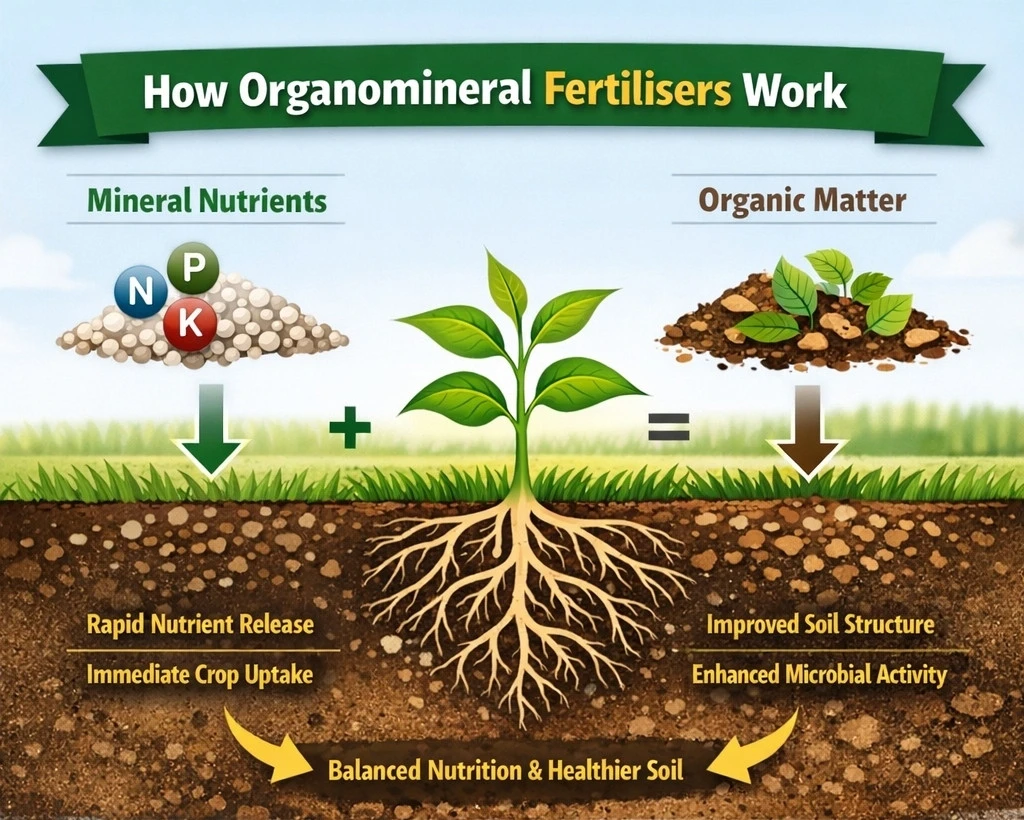
A standard mineral fertiliser is designed to deliver nutrients quickly and precisely. That is useful when crops need immediate uptake, but it does not do much to improve soil structure or biological activity. Purely organic products can help soil condition, yet nutrient release is often less predictable and more dependent on moisture, temperature and microbial breakdown.
Organomineral fertiliser sits between those two approaches. It combines the reliability of mineral nutrition with the soil-supporting characteristics of organic matter. For commercial agriculture, that balance matters. It can reduce some of the volatility associated with nutrient losses while helping maintain productive soil over repeated cropping cycles.
This does not mean organomineral fertilisers replace every conventional product in every programme. In high-demand stages, many growers still require targeted mineral inputs. The advantage is that organomineral fertilisers can strengthen the overall nutrition strategy and improve how efficiently the system performs.
Key organomineral fertiliser benefits for commercial crops
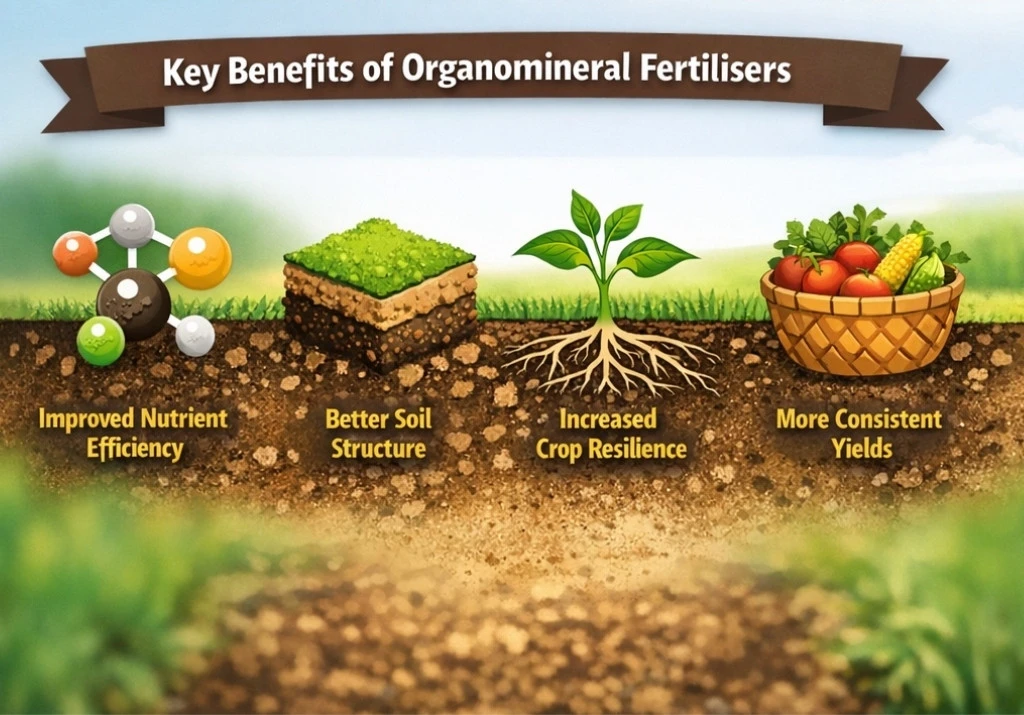
The strongest commercial case for organomineral fertiliser is not based on a single benefit. It comes from the combined effect on nutrient use, root-zone conditions and crop response.
Better nutrient efficiency
One of the main organomineral fertiliser benefits is improved nutrient efficiency. The organic fraction can help retain nutrients in the soil profile and moderate how quickly they are released or lost. That is especially relevant for nitrogen and other mobile nutrients that may be vulnerable to leaching or volatilisation under unsuitable conditions.
For growers, better efficiency means more of the applied nutrient is available to the crop rather than being lost from the system. In practical terms, that can support stronger uptake, more even crop development and better return on each tonne applied.
Improved soil condition
Soil is not only a medium for holding roots. It is a working system that affects water movement, aeration, microbial activity and nutrient exchange. Where soils have low organic matter or show signs of structural decline, crop performance often becomes less predictable.
Organomineral products can contribute to better soil condition by adding organic material alongside mineral nutrition. Depending on the formulation and soil type, this may support aggregation, moisture retention and root penetration. On heavier soils, better structure can help reduce compaction-related stress. On lighter soils, improved water-holding capacity can be valuable during dry periods.
Stronger root development and crop resilience
Crops perform better when the root zone stays active and accessible. By supporting both immediate nutrient availability and a healthier soil environment, organomineral fertilisers can encourage stronger rooting. That matters well beyond early establishment.
A better-developed root system generally improves the plant’s ability to access water and nutrients during stress periods. This does not eliminate the effects of drought, salinity or temperature swings, but it can help reduce the severity of the response. For commercial production, resilience often shows up as more stable performance across variable field conditions.
More consistent yield and quality
High yield depends on more than total nutrient volume. Timing, availability and root-zone performance all influence how effectively the crop converts inputs into marketable output. Organomineral fertilisers can help smooth some of the inconsistency caused by uneven nutrient release or poor soil condition.
The result is often seen in better crop uniformity, steadier growth and more reliable quality parameters. The scale of improvement depends on crop type, soil condition and application programme, but consistency is one of the reasons these products are gaining traction in professional farming systems.
Why organomineral fertiliser benefits matter more in stressed soils
The value of organomineral fertilisers tends to increase where soils are under pressure. Continuous cropping, limited organic matter return, salinity issues and high input intensity can all reduce soil performance over time. In these situations, simply applying more mineral fertiliser does not always solve the problem.
When nutrient use efficiency is already compromised, extra application may increase cost without delivering proportional crop response. Organomineral fertilisers can offer a more balanced correction by addressing both feeding and soil function. That is particularly relevant in operations where yield stagnation is linked to declining soil quality rather than a simple nutrient shortage.
It is still important to stay realistic. Severely degraded soils usually need a broader management response, including pH correction, irrigation management or changes to crop rotation. Organomineral fertiliser works best as part of a disciplined agronomic plan, not as a stand-alone fix.
Where organomineral fertilisers fit in a professional nutrition programme
For most large-scale operations, the question is not whether to use one product type exclusively. The better question is where each product delivers the strongest return. Organomineral fertilisers often fit well in base applications, soil-building programmes and fertility plans aimed at improving season-long efficiency.
In arable systems, they can support early nutrient availability while contributing to better soil condition over time. In intensive horticulture and permanent crops, they may help maintain productive root zones where repeated fertilisation places pressure on the soil environment. For distributors and private label buyers, the appeal is also commercial – these products answer demand for higher-efficiency fertiliser solutions without forcing growers into an entirely different nutrition model.
Product quality matters here. Not all organomineral fertilisers perform equally well, because nutrient ratios, raw material quality, granulation consistency and manufacturing control all affect field results. Buyers sourcing at scale need products with dependable composition, physical stability and repeatable performance from batch to batch.
Choosing for performance, not just specification
A product sheet tells you the declared nutrient content, but commercial performance depends on more than headline analysis. The source and treatment of organic matter, compatibility of mineral and organic components, and uniformity of granule size all influence application quality and crop response.
This is where manufacturing capability becomes important. A producer-led supplier can control formulation, raw materials and production standards more effectively than a business built only around trading. For importers, wholesalers and large farming operations, that control reduces risk across procurement, logistics and field use.
When assessing options, it makes sense to look at crop target, soil constraint and application method together. A broad-acre cereal programme may require a different organomineral balance from a high-value fruit or vegetable system. The right fit is usually the one that improves nutrient efficiency and field performance without complicating operations or supply planning.
A practical view of return on investment
The financial value of organomineral fertilisers should be measured across more than one season. Some benefits, such as nutrient availability and crop response, can show up quickly. Others, especially those linked to soil condition, tend to build over time.
For procurement teams, that creates a useful distinction. If the goal is the cheapest short-term nutrient unit, a conventional mineral option may appear stronger on paper. If the goal is improved efficiency, more stable yields and better soil function under commercial pressure, organomineral fertilisers often present a stronger long-term case.
That is why professional buyers increasingly assess these products through total system performance rather than simple cost per tonne. Reliability of supply, consistency of formulation and measurable agronomic response matter just as much as analysis.
For businesses sourcing at scale, this is also where an experienced manufacturing partner adds value. Suppliers such as FERTIZER, with in-house production and broad formulation capability, are better placed to deliver organomineral fertiliser solutions that meet both agronomic and commercial requirements.
The strongest fertiliser programmes are rarely built around trends. They are built around what improves crop performance, protects soil productivity and keeps supply dependable season after season. Organomineral fertilisers deserve attention for exactly that reason.