
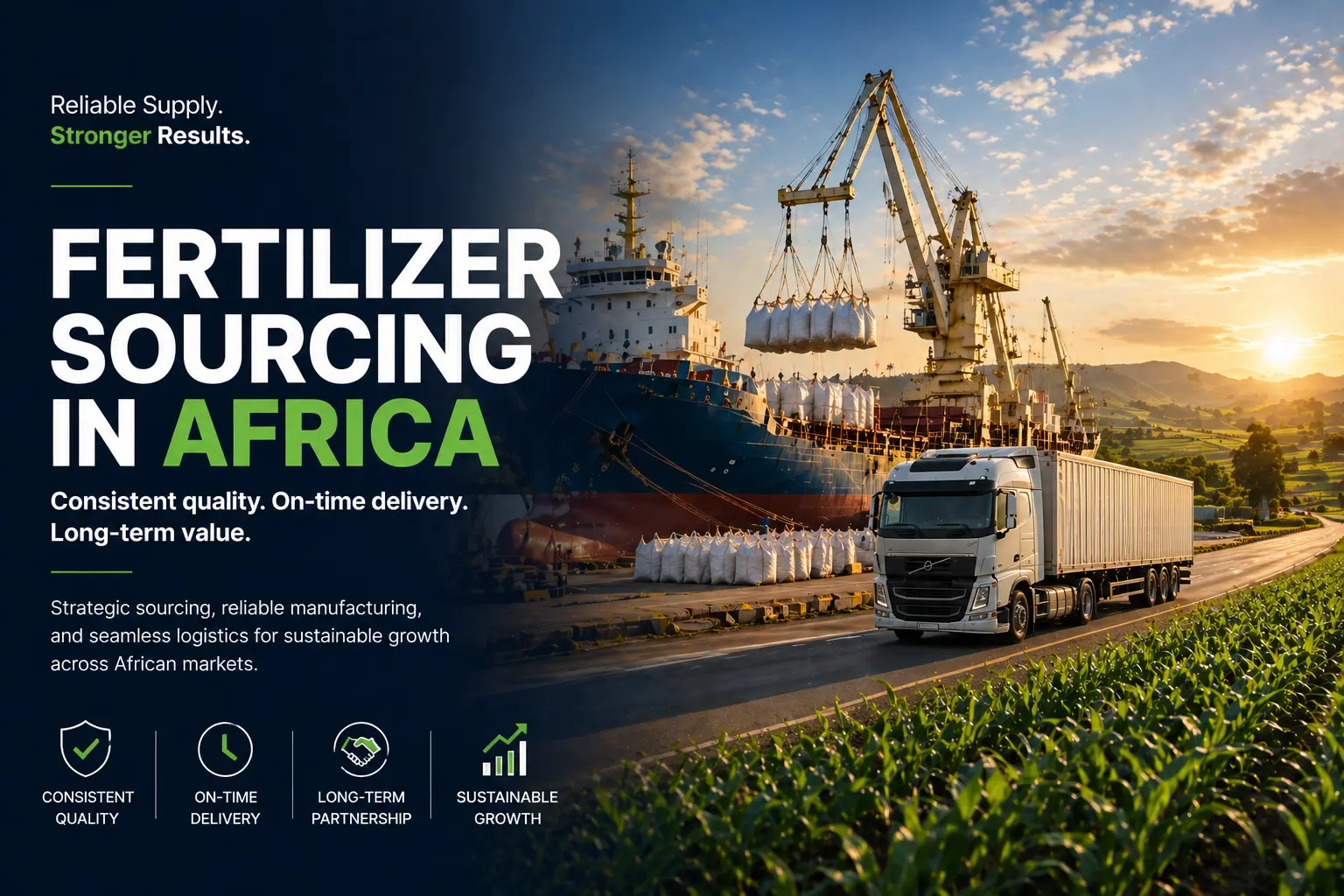
Procurement mistakes in fertilizer rarely show up at the warehouse door. In our experience supplying fertilizer to international distributors across multiple export markets, they show up later – in uneven crop response, delayed seasonal delivery, rejected specs, and margin pressure that could have been avoided at sourcing stage.
For companies evaluating fertilizer sourcing Africa distributors can rely on, the real question is not who can quote product fastest. It is who can supply consistently, at the right specification, with the production and logistics depth to support repeat business.
African fertilizer markets are not a single sourcing environment, as shown in recent research on African fertilizer market structure. Demand profiles, crop systems, soil constraints, import procedures, infrastructure quality, and product preferences vary widely by region. A distributor serving broad-acre grain in one market may need a very different portfolio from a buyer focused on horticulture, plantation crops, or specialty export agriculture in another. That is why sourcing decisions must be built around fit, not just price.
What fertilizer sourcing Africa distributors requires
Fertilizer sourcing for Africa distributors requires three core elements: product-market alignment, manufacturing consistency, and export execution.
The three core factors that define successful fertilizer sourcing can be summarized as follows:
| Core Factor | What It Means | Commercial Impact |
|---|---|---|
| Product-Market Alignment | Matching fertilizers with local crops and soil conditions | Improves yield response and customer satisfaction |
| Manufacturing Consistency | Stable quality, nutrient uniformity, low moisture content | Reduces claims and ensures repeat orders |
| Export Execution | Reliable logistics, documentation, and delivery timing | Prevents delays and protects distributor relationships |
These three factors determine whether a distributor can scale operations or face recurring supply chain issues.
Distributors operating across Africa typically need more than product availability. They need dependable volume planning, specification consistency, labeling flexibility, and supply partners that understand how nutrient performance translates into commercial performance. A low headline price can quickly lose value if the material arrives late, performs inconsistently, or creates claims in the field.
In practical terms, strong sourcing is built on three critical factors: product-market alignment, manufacturing credibility, and export execution. If one of those is weak, the supply chain becomes reactive. Distributors then spend time solving preventable issues instead of growing sales.
Product-market alignment with local agricultural systems
Product-market alignment is the process of matching fertilizer products with local crop systems and soil conditions. Misalignment leads to poor field performance and reduced commercial value.
- Crop type (cereals, horticulture, plantation crops)
- Soil characteristics (organic matter, pH, nutrient deficiency)
- Application method (fertigation, foliar, granular)
- Climate and irrigation conditions
In regions dealing with low organic matter and declining soil fertility, organomineral products or organic-based nutrition programs may create stronger long-term value than commodity-only positioning. In intensive production systems, water-soluble NPK fertilizers, liquid fertilizers, and micronutrient packages may be essential. The right supplier should be able to support a broad portfolio, not force every market into the same formula. This is why working with a technically capable fertilizer manufacturer is critical for long-term success.
Manufacturing credibility and quality consistency
Manufacturing credibility matters because distributors need repeatable quality. A producer with in-house formulation and production control can usually deliver tighter consistency than a supplier that depends entirely on opportunistic third-party sourcing. That difference affects granule quality, solubility, nutrient uniformity, packaging reliability, and ultimately customer confidence. For example, consistent suppliers maintain tight control over moisture levels, nutrient uniformity, and solubility standards. In high-quality Potassium Sulphate (SOP) products, potassium content typically reaches around 52% K2O with very low moisture content, ensuring both storage stability and field performance.
- Consistent nutrient composition across batches
- Low moisture content for better storage stability
- Uniform granule size or full solubility
- Reliable packaging for export handling
Export execution and logistics reliability
Export execution matters because timing is commercial. Missing a planting window is not a minor delay, as late fertilizer delivery remains a well-documented constraint in African agricultural systems (fertilizer logistics challenges in Africa). It can mean lost orders, damaged distributor relationships, and slower inventory turnover.
Suppliers with real export experience typically implement structured processes such as pre-shipment inspections, standardized documentation workflows, and container-level quality control to minimize delays and compliance risks.
- Pre-shipment inspection and quality control
- Accurate and complete export documentation
- Standardized container loading procedures
- Clear communication and lead time management
How to evaluate fertilizer sourcing partners for African distribution
The best sourcing conversations go deeper than product catalogs. Professional buyers should test whether a supplier can support a market over multiple seasons, under changing demand conditions, and across different crop segments.
- Does the supplier have in-house production capability?
- Can they provide consistent quality across shipments?
- Do they understand your target crop systems?
- Do they have proven export experience?
- Can they support portfolio expansion?
Start with production depth, not just trading capability
A supplier that operates as a fertilizer manufacturer has more control over quality, scheduling, and formulation. That does not mean every trader is unreliable, but it does mean a production-backed supplier often has more tools to solve problems before they reach the buyer. If raw material conditions shift or market demand changes, a manufacturer can often adapt formulations, packaging, or batch planning with greater speed and control.
For African distributors, this is especially relevant where import lead times, documentation requirements, and seasonal demand peaks require disciplined planning. A supplier with real production capability is generally better positioned to protect continuity.
Check portfolio breadth against real market demand
Many distributors do not serve one customer type. They may supply wholesalers, commercial farms, retailers, estates, and contract growers within the same market. That makes portfolio flexibility valuable.
A narrow supplier may be suitable for a specific tender or a single-volume item, but growth usually comes from being able to build out a wider offer. That can include organic fertilizers for soil improvement, organomineral products for balanced crop nutrition, soluble NPKs for fertigation programs, liquid fertilizers for efficient application, micronutrients for correction strategies, and raw material inputs for blending or manufacturing partners. This is particularly relevant for distributors developing their own branded products through private label fertilizer production models.
The trade-off is complexity. A broader portfolio requires stronger forecasting and technical support. But for many distributors, that complexity is worth it because it improves cross-selling opportunities and reduces dependence on one product line.
Look closely at quality consistency
A specification sheet is the starting point, not the proof, as fertilizer quality inconsistencies have been documented in several African markets (Fairbairn et al., 2016). Buyers should assess whether the supplier has systems that support stable quality across shipments. This includes raw material selection, batch controls, moisture management, particle uniformity where relevant, and packaging standards suitable for export handling.
Consistency matters even more in markets where growers are increasingly measuring return on input spend. If one shipment performs well and the next does not, distributors absorb the commercial fallout. Reliable sourcing protects not just product integrity but also brand credibility in the market.
Test export readiness early
Export problems often come from operational gaps that are easy to miss during negotiation. Documentation accuracy, packing discipline, container loading standards, lead time discipline, and communication speed all affect whether a shipment moves smoothly.
For fertilizer sourcing in Africa distributors should prioritize suppliers that understand cross-border trade as an operating function, not an afterthought. This is where experienced international suppliers stand apart. They know that a delayed document set or unclear packaging mark can create downstream costs that erode any pricing advantage.
Why product fit matters more than buying the cheapest ton
In price-sensitive markets, it is tempting to reduce sourcing decisions to cost per ton. But distributors rarely win on price alone for long. They win by supplying products that perform, arrive on time, and support stable customer relationships.
The cheapest product can become the most expensive if nutrient efficiency is poor, storage stability is weak, or application performance creates complaints. This is particularly relevant in segments where farmers are under pressure from rising input costs and need visible yield response from every application.
A better sourcing model looks at total commercial value. That includes nutrient concentration, handling quality, crop suitability, consistency, and the supplier’s ability to maintain availability. In many cases, a slightly higher acquisition cost supports better turnover and fewer claims, which improves margin quality over time.
Fertilizer sourcing Africa distributors should align with crop systems
A distributor serving cereals and row crops may prioritize bulk-ready NPKs, foundational nutrition products, and cost-efficient supply planning. A distributor focused on high-value horticulture may need cleaner soluble formulations, liquid feeding options, and precise micronutrient support. Plantation crops and export-oriented agriculture often require long-term soil fertility planning alongside immediate yield performance.
This is why serious sourcing should begin with market mapping. What crops drive fertilizer demand? What are the dominant nutrient deficiencies? How sophisticated are application practices? Is the market moving toward premium efficiency products, or is it still dominated by basic commodity demand?
There is no universal answer. In some markets, a simple, dependable standard product sold at scale is the right commercial move. In others, differentiation through specialty nutrition creates stronger growth. The strongest suppliers can support both paths.
What long-term distributors should expect from a supply partner
A serious supply relationship should improve over time. Forecasting should get sharper. Product planning should become more efficient. Communication should move faster. If every order feels like starting over, the partnership is not creating enough value.
Distributors should expect a supplier to think beyond the shipment. That means supporting volume planning, helping structure an appropriate product mix, maintaining stable quality, and being responsive when market conditions change. In a business where timing, performance, and trust all carry financial weight, reliability is not a soft benefit. It is part of the commercial model.
This is where a manufacturing-led supplier such as FERTIZER can offer a clear advantage. With full control over raw materials, formulation, and production, FERTIZER ensures consistent quality, low moisture content, and stable nutrient values across shipments. This allows distributors to reduce claims, improve reliability, and build long-term market trust.
For African distributors, that matters because opportunity is strong, but so is complexity. Markets are expanding, professional agriculture is advancing, and demand for better nutrient efficiency continues to grow. At the same time, buyers still have to manage logistics pressure, variable infrastructure, and performance expectations in the field.
The right sourcing approach does not eliminate those realities. It puts the distributor in a stronger position to manage them. When the supplier can combine product range, production discipline, and export reliability, sourcing becomes less about short-term availability and more about building a business that can grow season after season.
A good fertilizer supplier fills orders. A valuable one helps distributors protect reputation, support crop results, and scale with confidence.
Technical specifications, certificates of analysis (COA), and product samples are available upon request to support distributor evaluation, compliance checks, and onboarding processes.
Key Takeaways
- Fertilizer sourcing success depends on product-market alignment, manufacturing consistency, and export execution
- Product-market fit is more important than price alone
- Manufacturing consistency ensures long-term reliability
- Export execution directly affects commercial performance
- Choosing the right supplier reduces risk and supports growth
- Reliable suppliers combine product range, production control, and export capability