
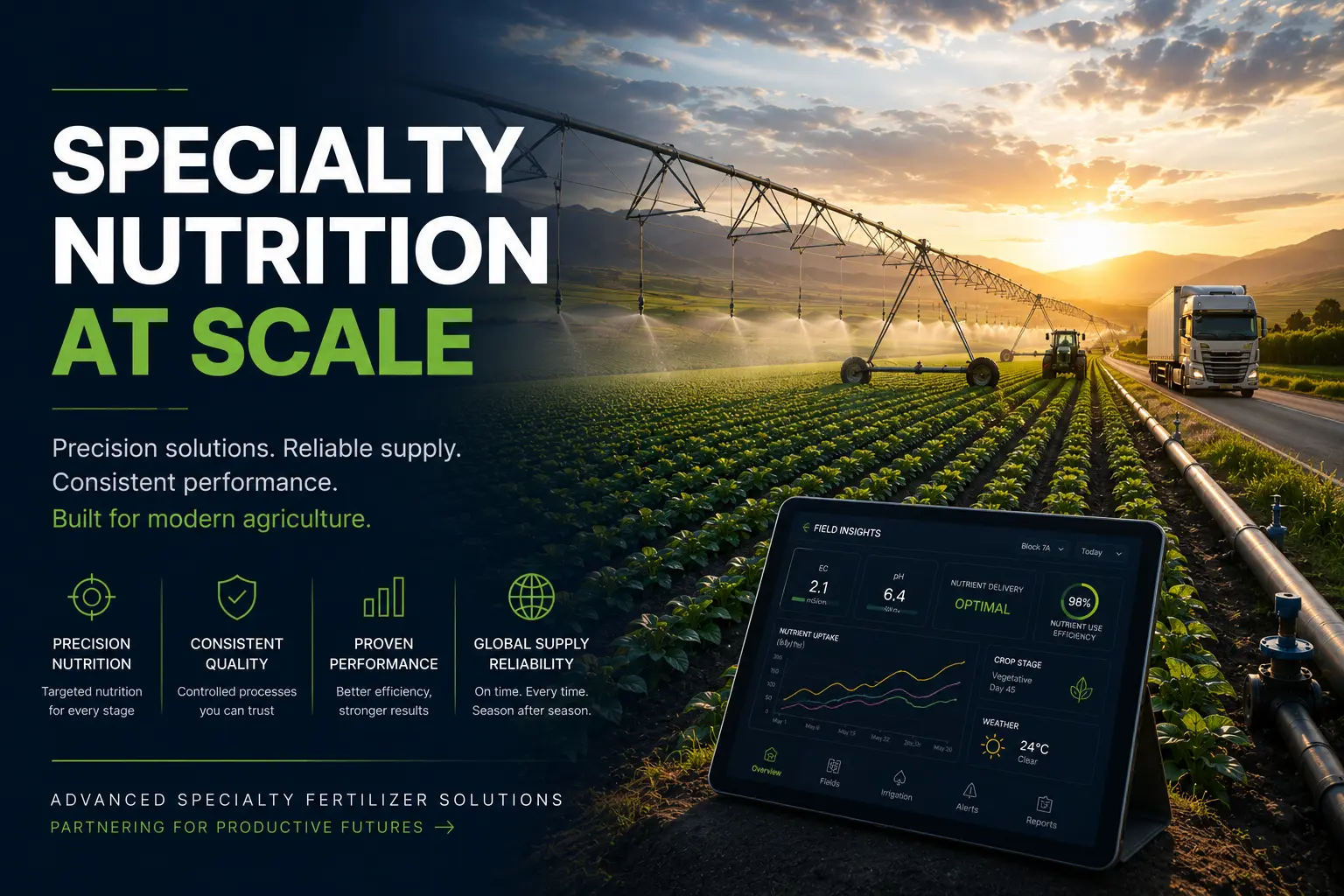
Procurement decisions are getting harder, not easier. Growers and distributors are being asked to deliver higher yields, better crop quality, and tighter nutrient efficiency while managing volatile raw material markets, stricter environmental expectations, and more variable growing conditions. That is exactly why the future of specialty fertilizers matters now – not as a trend topic, but as a practical sourcing and performance issue across commercial agriculture.
Specialty fertilizers are moving from a premium add-on to a core part of professional crop nutrition programs. In many segments, standard commodity nutrition alone no longer gives growers the control they need over nutrient timing, uptake, compatibility, and crop response. As margins tighten, the value of targeted formulations becomes easier to justify when they improve nutrient use efficiency, reduce application losses, and support more consistent field performance.
What will define the future of specialty fertilizers?
The next phase of the market will not be driven by novelty for its own sake. It will be defined by products that solve measurable agronomic and commercial problems. That means better nutrient availability, better fit for modern application systems, and better consistency across production lots.
- Higher nutrient availability under variable soil and water conditions
- Better compatibility with fertigation and precision application systems
- Consistent dissolution and tank-mix performance
- Reliable formulation quality across production batches
- Improved nutrient use efficiency and reduced application losses
- Stronger supply reliability for seasonal agricultural demand
Water-soluble NPKs, liquid fertilizers, micronutrient blends, chelated products, controlled-release inputs, and organomineral formulations all have a role to play. But demand will increasingly favor products that perform well under real operating conditions, not just on paper. Buyers want fertilizers that dissolve cleanly, mix predictably, apply efficiently, and produce repeatable crop responses across different regions and crop systems.
This is also changing how buyers evaluate suppliers. Product range still matters, but manufacturing control, raw material security, formulation capability, and export readiness matter just as much. For distributors and private label buyers, the future is not simply about finding a product. It is about building a supply chain that can support market growth without compromising quality.
Precision nutrition will keep raising the standard
One of the clearest forces shaping the future of specialty fertilizers is precision agriculture. As farms adopt better monitoring tools, tissue analysis, fertigation systems, and variable-rate application practices, fertilizer programs are becoming more exact. That creates stronger demand for nutrient inputs that can match that precision.
Commodity fertilizers remain essential, especially for baseline nutrient supply. But precision systems often reveal where generic programs fall short. A crop may require targeted calcium during fruit development, magnesium under intensive production, or trace elements at a specific physiological stage. In those moments, specialty fertilizers are not replacing conventional nutrition. They are refining it.
This shift favors formulations with high purity, strong solubility, and dependable compatibility. It also favors suppliers that understand application method, crop stage, and local agronomic realities. A technically strong product has limited value if it causes tank-mix problems, inconsistent nutrient delivery, or operational delays in the field.
In intensive fertigation systems, formulation quality directly affects operational performance. Poor dissolution, bicarbonate interaction, or unstable micronutrient chemistry can lead to precipitation problems, emitter blockage, and inconsistent nutrient delivery. That is one reason professional growers increasingly prioritize high-purity specialty fertilizers with predictable behavior under real irrigation conditions, not just guaranteed analysis on paper.
There is a trade-off here. More specialized nutrition can improve efficiency, but it can also increase program complexity. The right solution depends on crop value, irrigation method, soil condition, and management capacity. High-value horticulture, intensive row crops, and export-focused production systems will likely adopt specialty inputs faster than lower-margin segments, but the direction is clear across the market.
Efficiency will matter more than volume
For years, fertilizer purchasing often centered on nutrient tonnage and short-term price. That mindset is changing. Rising input costs and pressure on farm profitability are pushing buyers to focus more on delivered efficiency per unit of nutrient, not just cost per ton.
| Traditional Purchasing Focus | Emerging Specialty Fertilizer Focus |
|---|---|
| Cost per ton | Nutrient efficiency per application |
| Bulk nutrient volume | Crop response consistency |
| Generic formulations | Crop-specific nutrition strategies |
| Short-term pricing | Long-term operational performance |
| Standard application methods | Precision fertigation compatibility |
Nutrient efficiency is becoming a stronger purchasing factor
This is where specialty fertilizers have a stronger long-term case. Products that improve nutrient uptake, reduce leaching, enhance root development, or correct deficiencies faster can create better return on investment than lower-cost alternatives that underperform in the field. The economics are especially clear where water quality, soil pH, salinity, or climate stress reduce the effectiveness of standard programs.
For example, alkaline soils and high-pH irrigation water can significantly reduce the availability of certain micronutrients, particularly zinc, iron, and manganese. In these environments, chelation stability and formulation compatibility become critical factors in nutrient efficiency rather than secondary product features.
Micronutrients and organomineral solutions will play a larger role
Organomineral fertilizers are part of this story. As soil degradation and low organic matter continue to affect commercial production in many regions, buyers are looking for solutions that support both immediate crop feeding and longer-term soil function. Organomineral products can help bridge that gap by combining mineral nutrition with organic matter benefits, though performance depends heavily on formulation quality and raw material consistency.
Micronutrients will also gain importance. Deficiencies in zinc, boron, iron, manganese, and other trace elements can quietly limit yield and quality even when NPK programs look adequate. The future market will reward suppliers that can offer crop-specific and region-specific micronutrient strategies rather than generic blends with weak field relevance. This is also increasing interest in custom specialty fertilizer solutions designed around specific crop requirements, application systems, and local growing conditions.
The future of specialty fertilizers depends on manufacturing discipline
A major misconception in the market is that specialty fertilizers are mainly a branding exercise. In reality, their value depends heavily on formulation precision and production control. Small differences in raw material quality, particle size, solubility, pH stability, and trace element balance can determine whether a product performs consistently at scale.
Consistency testing, batch control, dissolution performance, and raw material verification are becoming increasingly important in specialty fertilizer manufacturing. Buyers operating fertigation and precision application systems cannot afford variability that creates operational risk during critical crop stages.
That is why manufacturing discipline will become even more important in the future of specialty fertilizers. Buyers are under pressure to reduce risk. They need confidence that every shipment matches specification, performs reliably in application systems, and arrives on schedule. This is especially critical for importers, distributors, and agricultural businesses managing seasonal demand windows.
Production-led suppliers have a clear advantage here. When a company controls formulation, manufacturing, and key supply inputs, it can protect product consistency more effectively than a business that only trades finished goods from changing sources. That matters not just for product quality, but for planning, documentation, technical support, and long-term commercial trust.
For private label buyers and regional brands, this point is even more important. Their reputation depends on consistent field performance across every batch they sell. As specialty categories grow, buyers will become more selective about who is actually producing the material and who is simply intermediating it.
Sustainability pressure will reshape product demand
Sustainability is often discussed too loosely, but in fertilizer markets it has practical implications. Regulators, food supply chains, and growers are all paying closer attention to nutrient losses, soil health, water management, and application efficiency. Not every specialty fertilizer solution delivers the same agronomic or environmental value. Products that improve application accuracy, nutrient retention, and operational efficiency are more likely to align with evolving sustainability expectations across modern agriculture.
Organizations such as the International Fertilizer Association (IFA) and the FAO continue to emphasize nutrient efficiency, soil management, and sustainable fertilizer practices as long-term priorities for global agriculture.
Water-soluble and liquid fertilizers will continue to benefit from this shift because they fit modern fertigation and precision delivery systems well. Controlled-release and stabilized formulations may also grow where labor efficiency, nutrient retention, and environmental restrictions justify their use. At the same time, organic and organomineral fertilizers are likely to expand in programs where soil improvement is becoming a strategic priority rather than a side consideration.
Still, sustainability claims need to be grounded in agronomic reality. A product that sounds advanced but does not fit local crop systems, climate conditions, or application practices will not create lasting value. The market is moving toward evidence-based decisions, where product selection is tied to crop outcomes, operational efficiency, and regulatory fit.
Global supply reliability will be part of product value
The future of specialty fertilizers is not only about formulation. It is also about supply reliability. Buyers across global markets have seen how quickly disruptions in raw materials, freight, and geopolitical conditions can affect availability and planning. In specialty categories, where formulations may depend on specific inputs and tighter quality standards, supply chain weakness becomes even more costly.
Why supply consistency matters in specialty fertilizer markets
That is why professional buyers are looking beyond product brochures. They want to know whether a supplier can scale, maintain consistency, support documentation, and deliver across multiple seasons. Strong technical products need strong commercial infrastructure behind them.
In seasonal agricultural markets, delayed shipments or inconsistent product quality can directly affect application timing and crop performance. For distributors and growers working within narrow production windows, supply reliability is often as important as formulation quality itself.
Integrated nutrition strategies are becoming more important
For businesses serving multiple regions and crop types, portfolio breadth also matters. The market is moving toward integrated nutrition strategies, where standard fertilizers, specialty blends, micronutrients, liquids, and organomineral products are used together. Suppliers that can support that full structure are better positioned to grow with their customers.
FERTIZER operates with this long-term market direction in mind by combining manufacturing capability, formulation control, raw material sourcing strength, and broad product coverage to support commercial buyers that require both agronomic performance and dependable global supply.
In practice, the success of a specialty fertilizer program rarely depends on a single product alone. Water quality, irrigation infrastructure, climate conditions, crop sensitivity, and application timing all influence field performance. That is why experienced growers and distributors increasingly evaluate specialty fertilizers as part of a complete nutrition strategy rather than isolated inputs.
The buyers who will gain the most from this shift are not the ones chasing the newest label. They are the ones building nutrition programs and supplier relationships around efficiency, consistency, and measurable crop results. Specialty fertilizers will keep evolving, but the principle behind their growth is straightforward: when every acre, every application, and every shipment matters, precision and reliability stop being premium features and become the standard.
As specialty fertilizer markets continue to evolve, growers, distributors, and procurement teams are also asking more specific questions about formulation quality, supplier reliability, and precision nutrition strategies.
Frequently Asked Questions
Specialty fertilizers are designed to improve nutrient precision, compatibility, and efficiency under specific crop and application conditions. Unlike conventional commodity fertilizers, they are often formulated for targeted nutrient delivery, fertigation systems, micronutrient correction, controlled nutrient release, or improved nutrient stability under challenging soil and water conditions.
Precision agriculture depends on accurate nutrient timing, efficient application methods, and consistent crop response. Specialty fertilizers support these systems by offering higher solubility, better compatibility with fertigation equipment, and more targeted nutrient availability during specific crop development stages.
Professional buyers increasingly evaluate suppliers based on formulation control, manufacturing consistency, raw material quality, technical support, export capability, and supply reliability. In specialty fertilizer markets, product performance often depends as much on production discipline and consistency as on nutrient composition itself.
Even small variations in raw material quality, solubility, particle size, or micronutrient stability can affect field performance and operational reliability. Consistent formulations help reduce risks such as precipitation problems, uneven nutrient delivery, and compatibility issues in fertigation and precision application systems.