
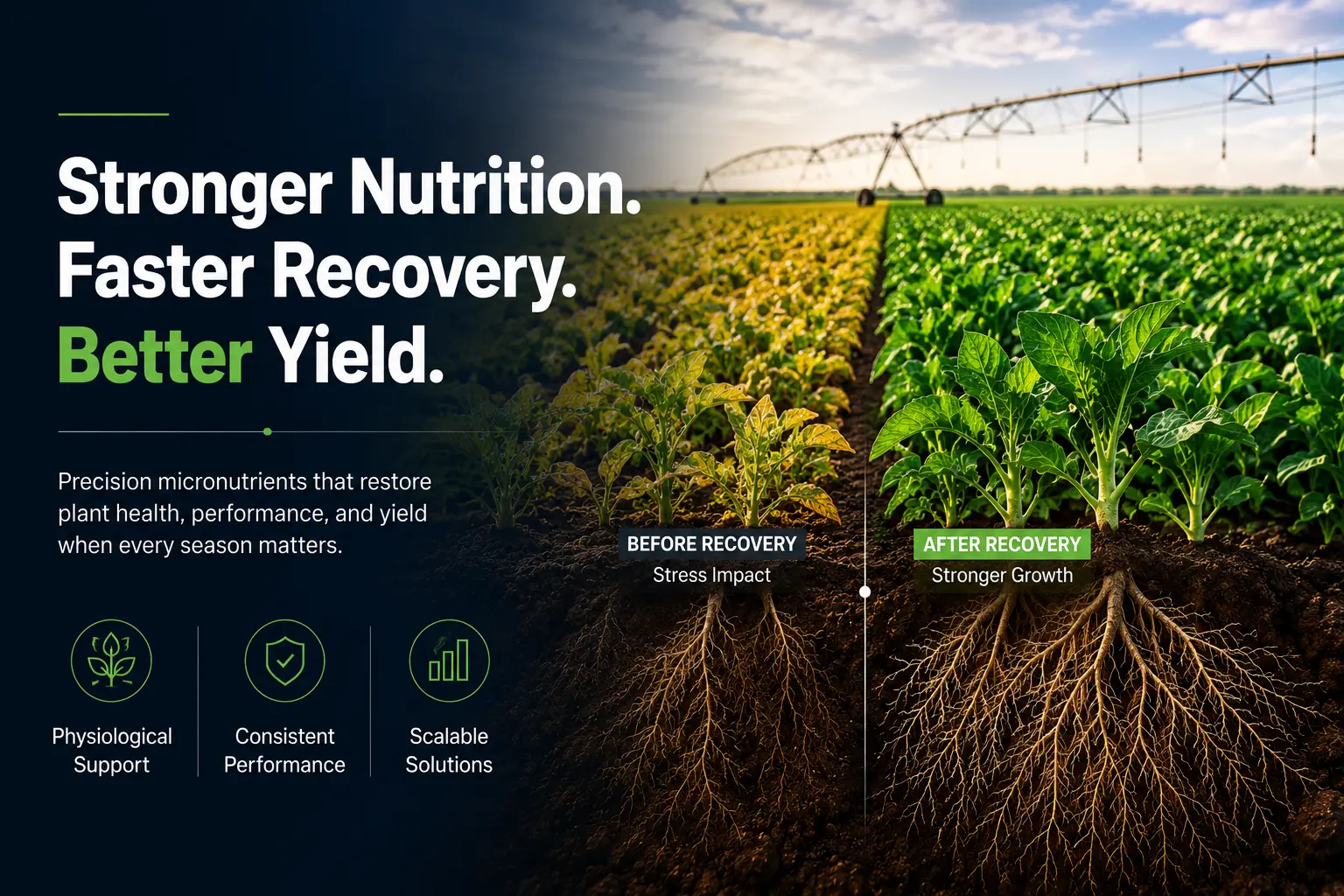
A field rarely loses momentum for just one reason. Heat, excess rain, salinity, root damage, herbicide stress, compaction, and uneven nutrient availability often hit at the same time. That is why choosing the best micronutrients for crop recovery is not about chasing a single deficiency symptom. It is about restoring metabolism, root activity, and new growth fast enough to protect yield potential.
For commercial growers and input buyers, the right recovery program also has to work at scale. A micronutrient may look effective on paper, but if it does not fit the crop stage, application system, water quality, or overall fertility plan, the response can be inconsistent. Recovery nutrition works best when micronutrients are selected for their physiological role, compatibility, and timing.
In commercial farming systems, recovery responses often vary significantly between fields even under the same fertilizer program. Growers dealing with salinity, compaction, or repeated irrigation stress frequently observe that micronutrient efficiency depends as much on root activity and water quality as on the nutrient itself. This is why recovery programs are typically adjusted according to field conditions rather than fixed formulas.
What crop recovery really requires
When crops are under stress, nutrient demand does not disappear. In many cases, it becomes more urgent while uptake becomes less efficient. Damaged roots absorb less from the soil, leaf area may be reduced, and plant energy is redirected away from aggressive vegetative growth toward survival and repair.
That changes the role of micronutrients. Instead of simply supporting background growth, they become part of a correction strategy. The goal is to restart enzyme activity, improve chlorophyll formation, support hormone balance, and strengthen the plant’s ability to build new tissue. This is why broad recommendations can miss the mark. A crop recovering from waterlogging does not behave the same way as a crop recovering from drought or a spray injury.
- Restarting enzyme activity
- Improving chlorophyll formation
- Supporting root recovery
- Restoring nutrient transport
- Reactivating vegetative growth
- Protecting reproductive potential
Best micronutrients for crop recovery by function
| Micronutrient | Main Recovery Function | Most Relevant Stress Conditions | Typical Application Focus |
|---|---|---|---|
| Zinc (Zn) | Enzyme activation and new growth | Cold stress, root restriction, slow vegetative recovery | Foliar and soil application |
| Manganese (Mn) | Photosynthesis and chlorophyll activity | Compaction, cloudy weather, alkaline soils | Foliar correction |
| Iron (Fe) | Chlorophyll rebuilding | Calcareous soils, bicarbonate irrigation | Chelated soil or foliar application |
| Boron (B) | Tissue formation and reproductive recovery | Flowering stress, fruit set problems | Low-dose precision application |
| Copper (Cu) | Structural strength and resilience | Weak regrowth, cereal deficiency | Targeted application |
| Molybdenum (Mo) | Nitrogen metabolism | Cool wet soils, legumes under stress | Low-rate support application |
Zinc for enzyme activity and new growth
Zinc is one of the most valuable micronutrients in recovery programs because it supports enzyme systems, protein synthesis, and growth regulation. Crops under stress often show shortened internodes, small leaves, and slow canopy restart, all signs that zinc availability may be limiting recovery.
Zinc is especially useful after cold stress, root restriction, or early-season setbacks where plant development stalls. It also plays a role in auxin metabolism, which matters when crops need to rebuild active growth points. In cereals, corn, rice, and many vegetable crops, zinc can be one of the first micronutrients to review when recovery is slow.
In high-pH cereal and corn production areas, foliar zinc applications are commonly used during early recovery because soil zinc availability can decline rapidly after cold and wet spring conditions. Many growers prefer combining zinc with early vegetative spray programs to accelerate canopy restart and shorten recovery time.
The trade-off is that zinc response depends heavily on form and placement. In high pH soils, soil-applied zinc can become less available, while foliar zinc can deliver a faster visual response but may not fully solve underlying soil limitations, a challenge also discussed by the University of Nebraska-Lincoln Extension.
Manganese for photosynthesis and stress metabolism
Manganese is central to photosynthesis and enzyme activation. If a crop has been under cloudy, wet, compacted, or alkaline conditions, manganese can become a hidden bottleneck. Recovery often depends on rebuilding chlorophyll function quickly, and manganese contributes directly to that process.
This is particularly relevant in soybeans, cereals, and other field crops grown on high pH or organic soils where manganese availability is commonly reduced. Plants that remain pale, sluggish, or uneven after stress may not need more nitrogen first. They may need the micronutrients that help the plant use that nitrogen efficiently.
In many large-acre soybean and wheat operations, manganese deficiency symptoms become more visible after extended cloudy periods or compacted soil conditions. Foliar correction is often used to restore chlorophyll activity quickly before yield loss becomes irreversible.
Foliar manganese is often effective for a rapid correction, but repeat applications may be needed if field conditions continue to limit root uptake. For large-acre programs, consistency of formulation matters because poor compatibility can create operational issues in spray tanks.
Iron for chlorophyll rebuilding
Iron is one of the best micronutrients for crop recovery when chlorosis is the dominant symptom, especially in young tissue. It supports chlorophyll synthesis and energy transfer, making it critical when crops need to restore active photosynthesis after stress.
Iron becomes more relevant in calcareous soils, high bicarbonate irrigation conditions, and fields where root function has been disrupted. In these situations, the crop may have enough total iron in the soil but still be unable to access it. That is an important distinction for procurement and agronomy decisions. More nutrient in the soil does not always mean more nutrient in the plant.
Iron availability typically decreases sharply in soils above pH 7.5, especially under high bicarbonate irrigation conditions. Under these conditions, visual chlorosis may appear even when total soil iron levels are technically sufficient, which aligns with findings published by Michigan State University Extension.
Iron products must be selected carefully. Soil applications can perform well when the right chelation is used for soil conditions, while foliar iron can provide a faster cosmetic improvement but may require follow-up support. The wrong form can reduce efficiency and raise cost per effective correction.
Boron for tissue formation and reproductive recovery
Boron is often underestimated in stress recovery because growers tend to associate it mainly with flowering and fruit set. In reality, boron is also essential for cell wall formation, sugar transport, and movement of growth processes within the plant. After stress, those functions matter because the crop is trying to rebuild tissue and reestablish internal transport.
Boron becomes especially important during reproductive stages, where delayed recovery can quickly translate into lower pollination, reduced fruit retention, or poor seed set. Proper boron nutrition during reproductive growth is therefore critical in many oilseed, fruit, and vegetable production systems.
The caution with boron is narrow margin. It is highly effective at the right rate and risky at excessive rates. That makes product quality, application accuracy, and crop-specific planning essential.
Commercial growers usually apply boron conservatively during recovery programs because the gap between deficiency and toxicity is relatively narrow in sensitive crops. Application timing and distribution uniformity therefore become critical management factors.
Copper for resilience and metabolic balance
Copper supports lignin formation, reproductive development, and several enzyme systems tied to plant resilience. It is not always the first micronutrient considered in recovery, but in cereals and some broadacre crops, copper deficiency can hold back regrowth and structural strength.
Where copper availability is low, plants may appear weak, floppy, or unable to convert recovery into stable growth. Copper can also support better pollen viability, which matters if the crop is recovering near reproductive transition.
Its use should be targeted, not routine. Copper is highly useful where soil or tissue data supports it, but less forgiving than zinc or manganese if applied without a clear need.
Molybdenum for nitrogen use after stress
Molybdenum is required in small amounts, but its effect can be significant where nitrogen metabolism is impaired. It helps plants convert nitrate into usable forms and is especially relevant in legumes because of its connection to nitrogen fixation.
After heavy rain, cool conditions, or root disruption, crops may receive nitrogen but struggle to process it efficiently. In that setting, molybdenum can improve recovery by helping the plant make better use of the nitrogen already present. It is rarely the headline nutrient, but in the right program it can improve overall response.
How to choose the best micronutrients for crop recovery
In commercial agriculture, tissue analysis is often used alongside soil testing to identify hidden micronutrient limitations during recovery periods. Visual symptoms alone may not accurately reflect nutrient availability, especially under stress conditions where uptake patterns can change rapidly.
The best micronutrient strategy starts with the stress event, not the product catalog. Crops affected by waterlogging and root damage often respond best to nutrients tied to chlorophyll formation, enzyme activity, and root restart, particularly zinc, manganese, and iron. During reproductive transition, boron and zinc may become more important if the crop is approaching bloom after stress. Poor nitrogen uptake despite adequate fertility can also indicate a need for manganese or molybdenum support.
Crop type also matters. Corn, cereals, soybeans, vegetables, orchards, and industrial crops each show different sensitivity patterns. Soil pH, organic matter, irrigation quality, and previous fertilizer history also affect which micronutrient will perform best and which formulation will remain available.
For commercial operations, there is also a procurement reality. A recovery product must deliver agronomic value while fitting storage, blending, transportation, and field application systems. Standardized quality and consistent supply are not side issues. They directly affect field performance when timing is tight.
- Storage stability
- Tank-mix compatibility
- Consistent nutrient concentration
- Reliable supply continuity
- Compatibility with large-scale spray systems
Application method makes a measurable difference
| Application Method | Main Advantage | Main Limitation | Best Use Scenario |
|---|---|---|---|
| Foliar Application | Fast nutrient response | Short residual effect | Immediate stress correction |
| Soil Application | Longer nutrient availability | Slower response time | Persistent soil deficiencies |
| Fertigation | Precise nutrient delivery | Requires irrigation infrastructure | High-efficiency commercial systems |
Foliar application is often the fastest route when immediate correction is needed. It can be highly effective after visible stress, especially when root uptake is restricted, and several published studies have reported improved nutrient uptake efficiency from foliar micronutrient applications under stress conditions.
In commercial-scale agriculture, foliar recovery programs are frequently selected because they allow faster intervention during narrow application windows. However, spray water quality, tank-mix compatibility, and environmental conditions can strongly influence final performance.
Soil or fertigation applications may provide a more durable response when the underlying problem is persistent low availability. In many commercial systems, the strongest approach is combined – a foliar application for rapid recovery followed by soil-based support to sustain growth.
Form matters as much as method. Chelated micronutrients, sulfates, complexes, and suspension formulations all behave differently. The right choice depends on crop sensitivity, tank mix plans, pH conditions, and operational scale.
For example, chelated micronutrients are generally preferred in alkaline soil conditions because they remain available to the plant for a longer period, while sulfate forms are often selected for cost-efficiency in less restrictive environments.
Recovery works better with balanced nutrition
Micronutrients do not repair a crop in isolation. They support recovery best when nitrogen, potassium, phosphorus, calcium, magnesium, and root-zone conditions are not severely limiting. A stressed plant cannot respond well to zinc or boron if it lacks the basic energy and structural inputs needed to produce new tissue.
This is where disciplined fertilizer planning adds value. Recovery should be treated as a performance adjustment within a full nutrition system, not as a last-minute rescue attempt. Manufacturers with strong formulation control and broad nutrient portfolios can support that process more reliably because the micronutrient choice can be aligned with the rest of the program rather than forced into a one-size-fits-all fix.
In practice, the most successful recovery programs are usually preventive rather than reactive. Commercial growers who respond early to stress signals generally protect more yield potential than those waiting for visible deficiency symptoms to intensify.
The best results usually come from early diagnosis, correct nutrient selection, and products built for consistent use in commercial agriculture. As highlighted by the International Fertilizer Association (IFA), balanced micronutrient management plays a major role in long-term crop productivity and stress resilience. Crop recovery is not about applying more inputs. It is about applying the right ones, in the right form, before the season moves on without you.
Frequently Asked Questions About Micronutrients for Crop Recovery
There is no single micronutrient that works best in every recovery situation. Zinc, manganese, iron, boron, copper, and molybdenum each support different physiological functions. The most effective choice depends on the type of stress, crop stage, soil conditions, and nutrient availability within the plant.
Foliar applications are usually preferred for rapid correction because nutrients can be absorbed directly through plant tissue. However, soil or fertigation applications may provide a more sustainable response when long-term nutrient availability is limiting. In many commercial farming systems, both approaches are combined for better recovery performance.
Response time depends on crop health, environmental conditions, nutrient form, and application method. Foliar applications may show visible improvement within several days, especially in chlorosis-related deficiencies, while soil-applied micronutrients generally require more time to influence new growth.
Yes. Micronutrients are required in small amounts, and excessive application can reduce recovery performance or even create toxicity problems. Boron and copper, in particular, require careful rate management because the margin between deficiency and excess can be relatively narrow in sensitive crops.
Tissue analysis is widely used in commercial agriculture to identify hidden nutrient limitations during recovery periods. It helps growers evaluate actual nutrient uptake within the plant, which may differ from soil nutrient availability under stress conditions.