
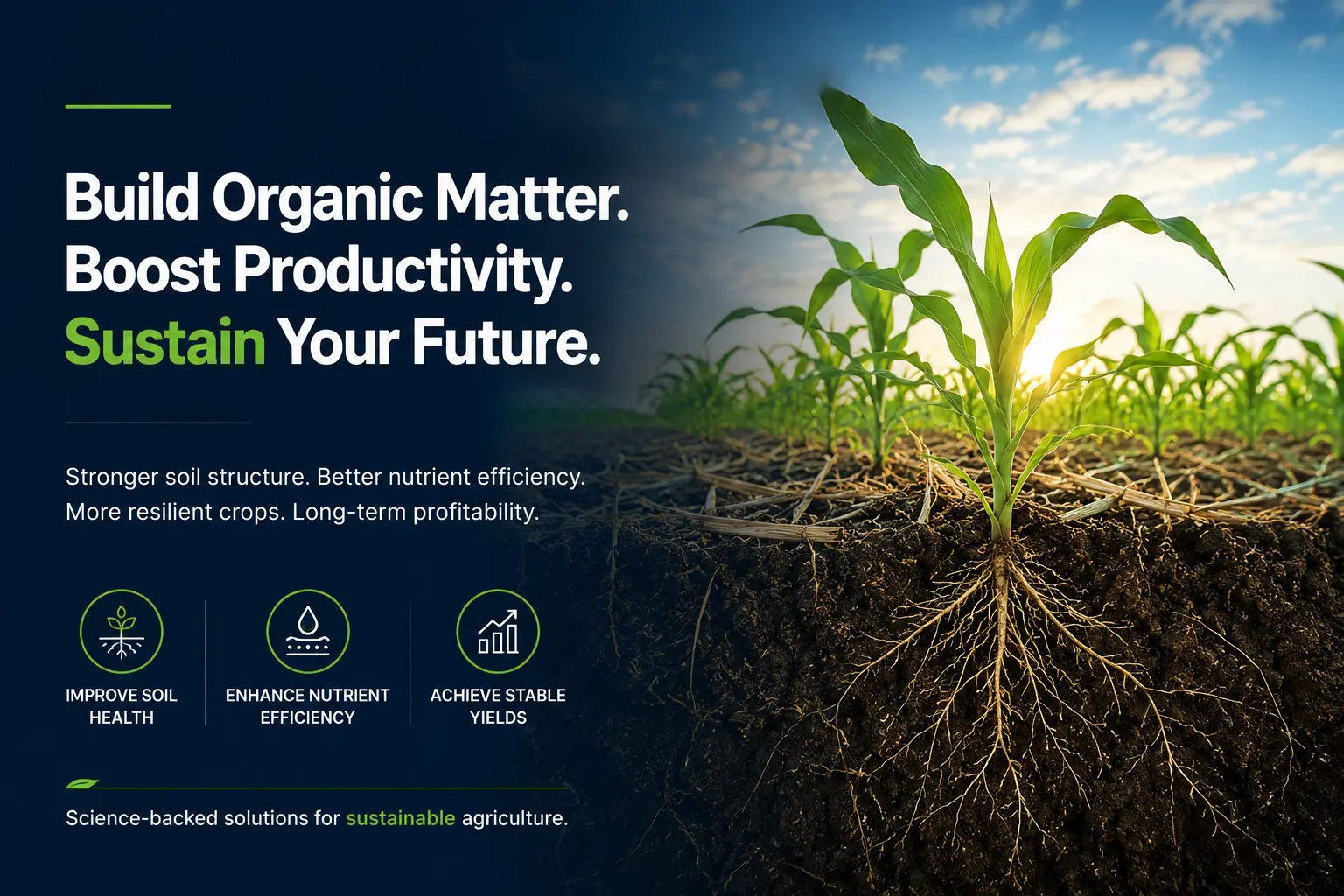
Low soil organic matter rarely shows up as a single problem. It appears as weak structure, uneven emergence, poor water holding, nutrient losses, and crops that do not respond to fertilizer as efficiently as they should. For commercial growers and procurement teams, that is why the question of how to increase soil organic matter is not academic – it is directly tied to input efficiency, yield stability, and long-term land productivity.
Organic matter is the engine behind many soil functions that support profitable crop production. It improves aggregation, supports microbial activity, increases cation exchange capacity, and helps soils hold both water and nutrients. But building it is not a one-season correction. It requires a disciplined program that combines residue management, organic inputs, balanced fertilization, and realistic expectations based on climate, soil type, and cropping intensity.
Organic matter is the engine behind many soil functions that support profitable crop production. According to FAO Soil Organic Carbon guidelines, increasing soil organic matter significantly improves nutrient retention, water use efficiency, and long-term soil productivity.
Why soil organic matter drops so easily
Organic matter is always moving. Crop residues are added, microbes decompose them, carbon is released, and a smaller fraction becomes more stable humus. In high-temperature regions, under aggressive tillage, or in systems with low residue return, the breakdown side of that equation moves faster than the rebuilding side.
That is why many productive farms still see gradual decline. Intensive cropping removes biomass. Bare fallow accelerates oxidation. Excessive tillage exposes protected organic fractions to rapid decomposition. Even strong fertilizer programs cannot fully compensate when soil structure and biology are under pressure.
The practical point is simple: if losses are faster than additions, soil organic matter falls. To reverse the trend, farms need to reduce breakdown while increasing the quantity and quality of carbon returned to the soil.
How to increase soil organic matter in commercial fields
The most effective strategy is not one input or one practice. It is a system. The farms that build organic matter consistently are usually combining crop residue retention, cover cropping where climate allows, organic or organomineral fertilization, and reduced disturbance.
Keep more biomass in the field
Residue removal may offer short-term logistical benefits, but it often reduces the most accessible source of carbon entering the soil. Where crop systems allow, retaining straw, stalks, and root biomass is one of the fastest ways to improve the organic matter balance.
This does come with trade-offs. Heavy residue can complicate planting, delay soil warming, or increase disease pressure in some rotations. The answer is usually not total removal or total retention in every case. It is better residue management – chopping evenly, distributing material behind harvest, and aligning equipment with the volume of biomass produced.
Root biomass matters as much as surface residue. Deep and dense rooting systems contribute carbon lower in the profile, where it may remain more stable. Crops and rotations that increase root mass often support more durable gains than systems focused only on above-ground residue.
Use cover crops strategically
Cover crops are one of the strongest tools for farms asking how to increase soil organic matter, but only when they are selected for the environment, water availability, and cash crop schedule. In regions with reliable moisture and adequate growing windows, they can add meaningful biomass, protect the surface, feed soil biology, and reduce nutrient losses.
Species selection should match the objective. Grasses typically contribute high biomass and carbon. Legumes help with nitrogen supply but may decompose faster. Mixed systems can improve balance, although they also add management complexity. In dryland systems or tightly timed commercial rotations, cover crops can compete for water or delay field operations. That does not make them ineffective – it means they must be evaluated economically and agronomically, not adopted as a blanket rule.
Reduce tillage intensity where practical
Tillage increases aeration and speeds decomposition. It can also break aggregates that physically protect organic matter. Over time, repeated disturbance makes it harder to maintain carbon stocks, especially in warm climates and low-residue systems.
Reduced tillage, strip-till, or no-till can help preserve organic matter, but the right system depends on soil texture, drainage, weed pressure, and crop type. Poorly executed no-till in compacted or poorly drained soils may create a different set of problems. The goal is not to eliminate tillage at any cost. It is to reduce unnecessary disturbance while protecting seedbed quality and crop establishment.
Apply organic and organomineral fertilizers with a long-term plan
Organic inputs add more than nutrients. They also contribute carbon that supports microbial processes and soil structure. Depending on the material, they can improve aggregation, moisture retention, and nutrient buffering while helping rebuild soil biological activity.
Not all organic fertilizers perform the same way. Their value depends on organic carbon content, nutrient analysis, mineralization pattern, consistency, and compatibility with the crop program. Materials with highly variable composition can make planning difficult, especially for commercial operations that need repeatable field results.
This is where professionally manufactured organic fertilizers and organomineral fertilizers have an advantage. They can combine carbon contribution with more predictable nutrient delivery, making them easier to integrate into commercial fertility programs. Organomineral products are especially useful where the priority is to raise nutrient efficiency while also supporting gradual improvement in soil condition.
For large-acre operations, the best results usually come from multi-season planning rather than occasional corrective applications. Organic matter does not rise quickly, so consistency matters more than one heavy application followed by several seasons of nutrient-only management.
Balance nutrition or organic matter gains will stall
One common mistake is assuming carbon additions alone will solve low organic matter. In reality, biomass production depends on balanced crop nutrition. If crops are short on nitrogen, phosphorus, potassium, sulfur, or key micronutrients, residue production drops and root development weakens. That limits the raw material available to build organic matter in the first place.
This is why farms with strong fertility programs often have better long-term organic matter outcomes than farms focused only on residue return. High-yielding crops create more biomass. More biomass means more carbon entering the system. The objective is not choosing between soil building and crop feeding. The two work together.
Balanced mineral nutrition also helps residues cycle more efficiently. When decomposition is too slow, residues can tie up nutrients and interfere with establishment. When it is too fast, little stable carbon remains. Proper nutrient management helps move that process toward productive cycling rather than waste.
Match the strategy to soil type and climate
There is no universal speed for building soil organic matter. Sandy soils usually struggle to hold it. Clay-rich soils often protect organic fractions more effectively. Hot and humid regions decompose residues faster than cool climates. Irrigated production may generate more biomass, but it can also accelerate microbial activity.
That is why realistic benchmarking matters. A 0.2 to 0.5 percentage point increase over several years can be meaningful at scale, especially on heavily farmed land. Chasing unrealistic short-term jumps often leads to poor investment decisions.
Sampling method matters too. Testing should be done consistently by depth, timing, and field zone. Surface gains in reduced-till systems may look strong, while deeper layers change more slowly. For commercial farms, trend tracking over time is more useful than reacting to a single test result.
Products support the process, but management drives the result
When evaluating inputs for how to increase soil organic matter, buyers should look beyond headline claims. The right product should fit the farm’s logistics, nutrient plan, application equipment, and crop system. Consistent manufacturing quality, stable raw material sourcing, and predictable analysis are critical, especially for distributors and large-scale growers managing broad acre programs.
A reliable soil-building program often includes a combination of organic fertilizers, organomineral fertilizers, and targeted mineral nutrition. The product mix will vary by crop and region, but consistency is what turns soil improvement from a concept into a measurable production advantage. That is the reason professional buyers increasingly prefer supply partners with in-house production capability rather than inconsistent spot-market sourcing.
For businesses building fertilizer programs across multiple markets, FERTIZER supports this need with scalable crop nutrition solutions designed for both performance and supply reliability.
What results should commercial growers expect?
Better organic matter management usually shows up before lab values move dramatically. Fields often gain improved tilth, better infiltration, stronger rooting, more even moisture behavior, and more stable crop response under stress. Those changes can reduce yield variability and improve return on fertilizer investment.
The financial impact is usually indirect at first, then cumulative. Better nutrient retention can reduce losses. Stronger soil structure can improve trafficability and establishment. Improved moisture holding can protect yield in dry periods. Over time, these gains can be as valuable as the organic matter increase itself.
The most productive approach is to treat soil organic matter as a performance metric, not just a soil test number. Build more biomass. Disturb the soil less when possible. Use organic and organomineral inputs strategically. Keep nutrition balanced. Then stay consistent long enough for the soil to return the favor.
Frequently Asked Questions (FAQ)
Building soil organic matter is a gradual process. In most commercial systems, a measurable increase of 0.2-0.5% may take several years depending on climate, soil type, and management practices. Consistency in residue management, fertilization, and reduced tillage is more important than short-term interventions.
Ideal soil organic matter levels vary by soil type. Sandy soils may perform well at 1-2%, while clay-rich soils often benefit from levels above 3-5%. The key is not only the percentage but also how effectively the soil supports water retention, nutrient availability, and root development.
There is no instant solution. However, combining high biomass production, cover cropping, organic or organomineral fertilization, and reduced tillage can accelerate the process. The most effective approach is a system rather than a single input.
Mineral fertilizers alone do not directly increase soil organic matter. However, they support higher crop yields and biomass production, which indirectly contributes to organic matter buildup when residues are returned to the soil.
Yes. If residue return is low or tillage intensity is high, soil organic matter can decline despite strong fertilization programs. Organic matter balance depends on both carbon inputs and decomposition rates.