
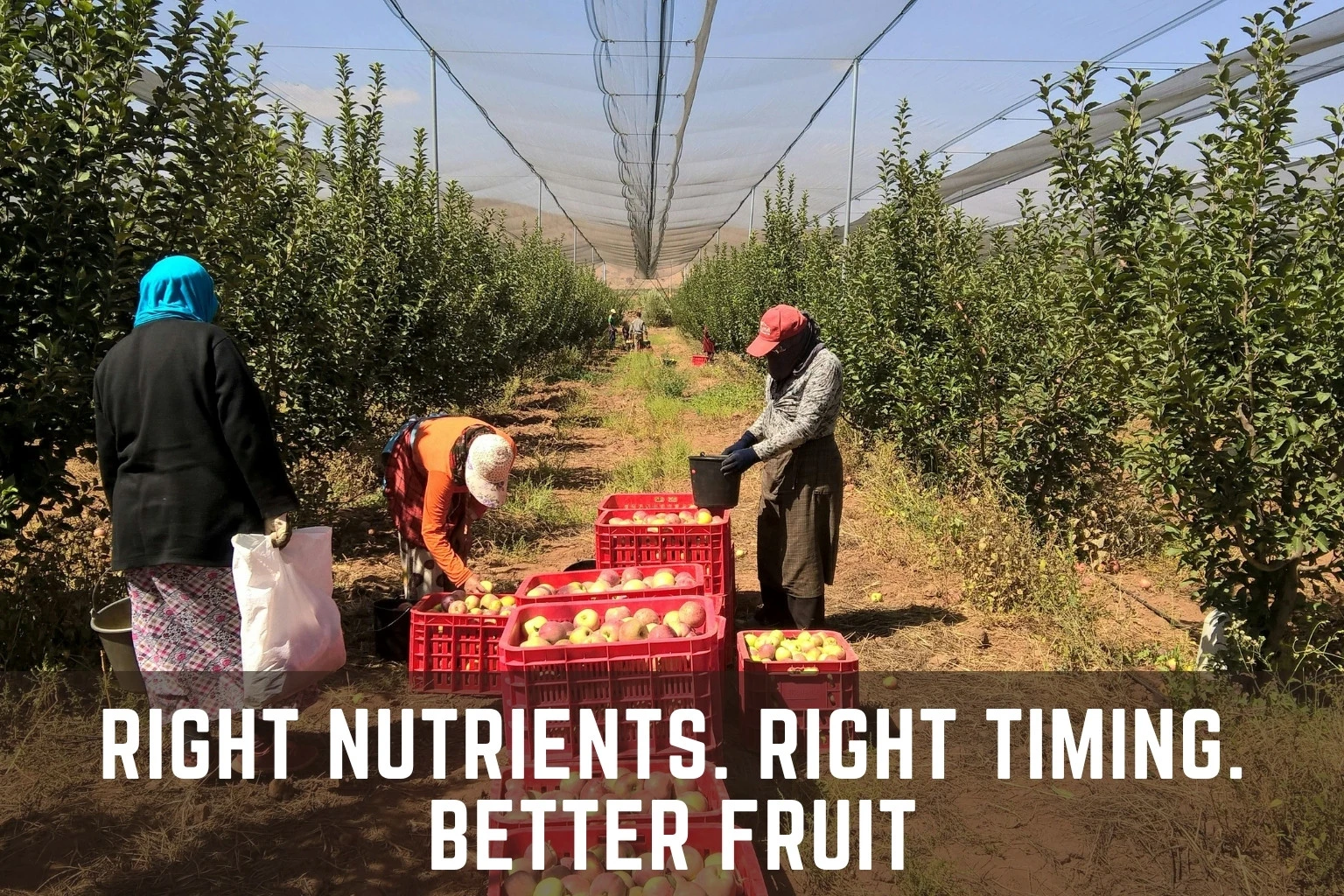
A profitable orchard rarely has a single nutrition problem. More often, pome fruit performance is shaped by timing, balance, and consistency across the full season. A strong fertilization program for pome fruits has to support root activity before bloom, canopy growth after fruit set, steady fruit sizing through summer, and reserve building after harvest. When any one phase is underfed or mismanaged, the impact shows up in packout, storage quality, and return bloom.
For commercial apple and pear production, nutrition planning works best when it is tied to crop load, soil condition, irrigation strategy, and the target market for fruit quality. High-yielding orchards need more than a generic NPK approach. They need a staged program that keeps nutrients available when demand is high, while limiting waste, salt stress, and unnecessary cost.
What a fertilization program for pome fruits must achieve
Pome fruits place long-duration demand on the root zone and canopy. Unlike short-cycle crops, the orchard is building both the current crop and next season’s productive potential at the same time. That changes how fertilizer should be selected and applied.
Nitrogen drives vegetative growth, leaf area, and early fruit development, but excess nitrogen creates trade-offs. Too much can reduce color development, soften fruit, delay maturity, and increase susceptibility to storage disorders. University-backed research from Washington State University also highlights the importance of balanced nitrogen management in maintaining fruit quality and avoiding excessive vegetative growth. Potassium is essential for fruit sizing, sugar movement, and quality, yet heavy potassium use can interfere with calcium and magnesium uptake if the balance is poor. Phosphorus supports root development and energy transfer, especially in cool early-season conditions, but orchard response depends heavily on soil availability and pH.
Calcium deserves special attention in apples and pears because market value depends on firmness, shelf life, and resistance to physiological disorders. Boron, zinc, iron, manganese, and magnesium also matter, but their value comes from precision. A deficiency correction can improve flowering, fruit set, and leaf function. An unnecessary application only adds cost.
That is why the best programs are built around measured need, not habit. Soil analysis, leaf analysis, irrigation water quality, and orchard history should guide formulation and timing. This approach is also aligned with internationally recognized frameworks such as FAO guidelines, which emphasize balanced and site-specific nutrient management for sustainable crop production.
Start with the orchard baseline
Before choosing products, establish the nutrient supply environment. Soil texture, cation exchange capacity, organic matter, pH, salinity, and bicarbonate load all influence fertilizer efficiency. In pome fruit orchards, the same nutrient rate can perform very differently in a sandy, fertigated block compared with a heavier soil under limited irrigation.
Leaf analysis is equally important because it shows what the tree is actually taking up. Soil may contain potassium or calcium, but uptake can still be restricted by moisture stress, root damage, antagonism from other nutrients, or unfavorable pH. For bearing orchards, combining pre-season soil data with in-season leaf analysis gives a much clearer basis for decisions.
Growers and procurement teams should also separate young orchards from mature, high-cropping blocks. Young trees need nutrition that favors root establishment and balanced canopy development. Mature orchards need crop-driven feeding with tighter control over nitrogen and stronger attention to potassium, calcium, and micronutrient timing.
Early season nutrition sets the pace
From bud break to fruit set, the objective is to support root activity, flowering, and early cell division without overstimulating vegetative growth. This is the period when phosphorus availability, boron supply, and moderate nitrogen can influence reproductive performance.
Where fertigation is available, water-soluble NPK fertilizers can improve placement accuracy and uptake efficiency. Early season formulas with a stronger phosphorus component are often useful in cool soils where root activity is limited. In orchards with low organic matter or weak soil structure, combining mineral nutrition with organic or organomineral inputs can support better root-zone performance over time. To better understand how water-soluble NPK fertilizers work in crop production systems, it is important to consider their composition, solubility, and application methods.
Boron is commonly included ahead of bloom or around bloom where analysis or orchard history indicates need. It supports pollen viability and fruit set, but rates must be controlled carefully. Zinc may also be important in blocks with weak leaf expansion or known deficiency. The key is not to apply every micronutrient by default. The correct program solves a defined constraint.
Fruit set to sizing requires disciplined nitrogen and potassium management
Once fruit is set, nutrient demand shifts. Trees need enough nitrogen to sustain healthy leaf area and shoot function, but this is where excess application starts to hurt fruit quality. In high-density orchards, aggressive nitrogen can quickly push vegetative growth beyond the target and create shade-related quality loss.
A practical approach is to split nitrogen through fertigation or multiple controlled applications rather than relying on one large dose. This improves nutrient efficiency and gives managers room to adjust based on crop load, shoot growth, and weather. Light crops generally need less nitrogen than heavy crops. Vigorous orchards also need tighter nitrogen control than weaker blocks.
Potassium demand rises strongly during fruit development. It supports transport of carbohydrates to the fruit and contributes to size, color development, and soluble solids. However, potassium should not be pushed without considering calcium balance. In orchards with a history of bitter pit, cork spot, or poor storage performance, potassium strategy should be reviewed alongside calcium nutrition and crop load.
This is where product quality matters. Consistent raw materials, predictable solubility, and uniform composition are critical for commercial orchards using fertigation or precision feeding systems. Inconsistent supply creates field variability, and field variability quickly becomes a commercial problem.
Calcium is not optional in pome fruit programs
For apples and pears destined for storage or premium fresh markets, calcium management is often the difference between acceptable and high-value fruit. Calcium moves poorly within the plant, so relying only on soil-applied calcium is often not enough, especially under rapid fruit growth or irregular irrigation.
A complete program usually combines sound root-zone management with targeted foliar calcium applications during fruit development. The exact schedule depends on cultivar, crop load, vigor, and disorder risk. High-cropping orchards, large-fruited varieties, and blocks under strong vegetative growth typically need tighter calcium planning.
Calcium performance also depends on what is happening elsewhere in the program. Excess nitrogen, excess potassium, and uneven water supply all work against good calcium distribution to the fruit. That is why calcium should not be treated as a separate correction at the end of the season. It has to be protected through the whole nutrient strategy.
Late season and post-harvest feeding matter more than many programs allow
Late-season nutrition affects more than the current harvest. It influences reserve accumulation, bud development, and next year’s start. After harvest, trees are still physiologically active if leaves remain healthy and conditions support uptake. This window can be valuable for rebuilding nutrient reserves, especially nitrogen and potassium where justified by crop removal and orchard condition.
The decision here depends on timing and climate. In regions with a short post-harvest period, late applications may have limited return. In longer post-harvest conditions, a measured feeding strategy can support stronger spring performance. The point is not to fertilize automatically after harvest. It is to use the post-harvest period when the orchard can still convert nutrients into stored value.
Matching product form to orchard system
The best fertilization program for pome fruits also depends on delivery method. Granular base fertilizers can support preseason soil building and broad nutrient placement. Water-soluble fertilizers are better suited to fertigated orchards that require precise timing and adjustable dosing. Liquid fertilizers are commonly used in crop production systems where uniform nutrient delivery and rapid plant uptake are required, making them especially effective in large-scale operations. For a deeper understanding, see how liquid fertilizers are used in crop production.
Organic and organomineral fertilizers can play an important role in orchards dealing with low organic matter, poor soil structure, or weak biological activity. They are not a replacement for all mineral inputs in high-output systems, but they can improve the efficiency of the broader nutrition plan when used strategically.
For distributors, importers, and large-scale growers, this is where supplier capability becomes commercially important. A broad portfolio allows nutrition programs to be built around orchard need rather than around a narrow product catalog. Production consistency, export readiness, and dependable bulk supply are not side issues. They directly affect seasonal execution.
Common mistakes that reduce return on fertilizer investment
The biggest mistake is treating all orchards the same. Variety, rootstock, planting density, irrigation, crop load, and market destination all influence nutrient demand. A program that performs well in one block may underperform in another.
The second mistake is overfeeding nitrogen to chase canopy growth. This often creates temporary visual improvement while reducing fruit quality and nutrient efficiency. The third is ignoring calcium until disorder symptoms appear. By then, the problem is usually structural within the season.
Another common issue is relying on annual habit instead of analysis. Input costs are too high for blind application. Programs should be adjusted with data, especially when weather patterns, yield targets, or irrigation conditions change.
FERTIZER supports commercial agriculture with fertilizer solutions built for consistency, performance, and scalable supply, which is exactly what orchard nutrition programs require when precision and reliability both matter.
The strongest orchard programs are not the most complicated. They are the ones that match nutrient timing to tree demand, protect fruit quality while supporting yield, and stay flexible enough to respond to field reality as the season develops.
Frequently Asked Questions (FAQ)
The best fertilization program for pome fruits is a stage-based approach that aligns nutrient supply with tree demand throughout the season. It should include early-season support for root activity and flowering, balanced nitrogen and potassium during fruit development, and adequate calcium to ensure fruit quality and storage performance.
Calcium is critical for improving fruit firmness, shelf life, and resistance to physiological disorders such as bitter pit. Since calcium movement within the plant is limited, both soil and foliar applications are often required for effective results.
Nitrogen supports vegetative growth, leaf development, and early fruit formation. However, excessive nitrogen can reduce fruit color, delay maturity, and negatively impact storage quality, so it must be carefully managed.
Potassium is most important during fruit development and sizing stages. It supports sugar transport, fruit size, and overall quality, but should be balanced with calcium to avoid nutrient antagonism.
Both soil and leaf analysis are essential. Soil analysis shows nutrient availability, while leaf analysis indicates actual nutrient uptake by the tree. Using both together allows for more accurate and efficient fertilization planning.
Water-soluble fertilizers are highly effective in fertigated orchards because they allow precise nutrient delivery and quick uptake. They are especially useful during periods of high nutrient demand.
Liquid fertilizers are well suited for large-scale commercial orchards where application uniformity and operational efficiency are important. They allow fast and consistent nutrient delivery across large areas.