
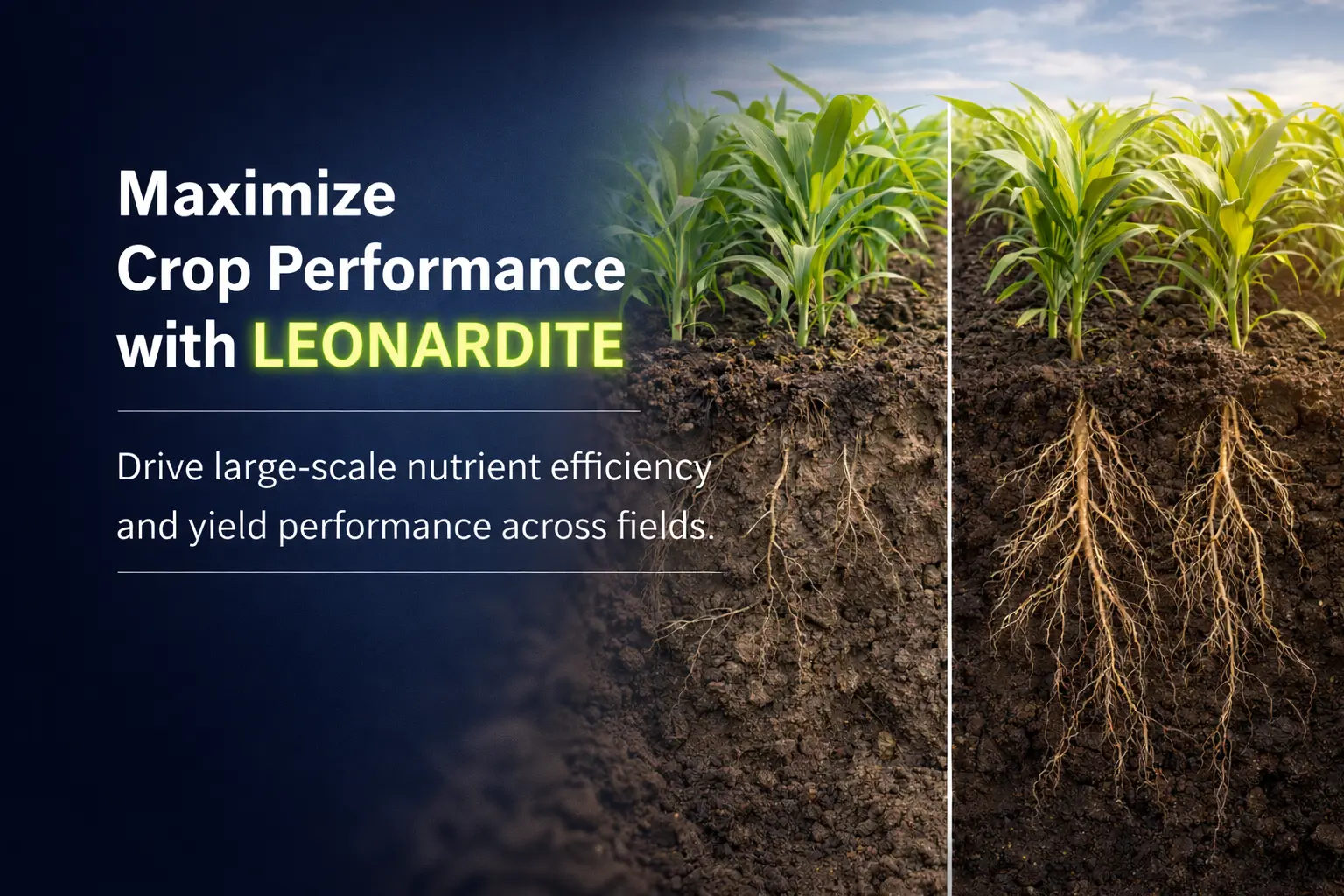
Margins tighten quickly when soils stop responding to standard nutrition programs. In many commercial operations, the issue is not only nutrient rate – it is nutrient efficiency, soil structure, and the declining biological and chemical conditions that limit crop performance. That is where leonardite fertilizer benefits become commercially relevant. Used correctly, leonardite-based inputs can improve nutrient availability, support root development, and help growers build more resilient production systems over time.
What makes leonardite different
Leonardite is an oxidized form of lignite, valued in agriculture for its high concentration of humic substances, especially humic acid and fulvic acid. Unlike conventional NPK products that primarily deliver direct nutrition, leonardite works more as a performance enhancer within the soil-plant system. Its role is to improve the conditions under which nutrients are held, exchanged, and absorbed, particularly through its impact on humic substances and soil health.
For professional buyers and large-scale growers, that distinction matters. A product that helps the soil retain nutrients, buffer stress, and improve fertilizer efficiency can influence both yield stability and input economics. Leonardite is not a replacement for a full fertility program, but it can strengthen one significantly.
Leonardite fertilizer benefits in commercial agriculture
The strongest value of leonardite appears when it is evaluated beyond a single application cycle. Its effects are often cumulative, especially in soils with low organic matter, weak cation exchange capacity, compaction issues, or poor nutrient utilization.
Better nutrient retention and uptake
One of the most recognized leonardite fertilizer benefits is improved nutrient management. Humic substances help increase cation exchange capacity, which supports the retention of key nutrients such as potassium, calcium, magnesium, and ammonium in the root zone. In practical terms, that can reduce losses and improve the proportion of applied nutrients that actually contribute to crop growth.
This is especially useful in intensive production systems where fertilizer costs are high and nutrient leaching or fixation is limiting returns. In sandy soils, improved holding capacity can support more stable feeding. In heavier soils, humic substances may help reduce nutrient lock-up and improve nutrient mobility around the rhizosphere.
Stronger root development
Root performance drives crop performance. Leonardite-based fertilizers are often used to encourage deeper, denser root systems by improving soil conditions and stimulating physiological activity in the root zone. Better rooting typically means improved water uptake, stronger early establishment, and greater resilience under stress.
This matters in row crops, vegetables, orchards, and other high-value systems where uniformity and early vigor affect final output. Strong roots also give growers more flexibility when conditions become less favorable, whether the challenge is heat, irregular irrigation, or temporary nutrient imbalance.
Improved soil structure and microbial activity
Soil productivity is not only chemical – it is physical and biological. Leonardite contributes organic carbon and humic compounds that can support aggregate stability, aeration, and water infiltration. In compacted or tired soils, these improvements can help create a more active root environment.
Humic substances can also stimulate microbial activity by supporting a more balanced soil ecosystem. That does not mean leonardite acts like a microbial inoculant, but it can create conditions that favor beneficial biological processes. For commercial production, healthier soil biology often translates into more efficient nutrient cycling and more consistent crop response.
Better stress tolerance
Crops rarely perform under ideal conditions from planting to harvest. Salt pressure, drought periods, temperature shifts, and transplant shock can all reduce growth and marketable yield. Another important leonardite fertilizer benefit is its ability to help plants tolerate these stresses more effectively, particularly in terms of improving plant tolerance to drought and nutrient stress.
This effect is partly indirect. When roots are stronger and nutrients are more available, plants are generally better equipped to maintain growth under pressure. In some cases, fulvic and humic fractions may also improve nutrient transport and metabolic activity, helping crops recover faster after stress events.
Higher fertilizer efficiency
In commercial farming, performance is measured not just by yield, but by yield per dollar spent. Leonardite can improve the efficiency of mineral fertilizers by reducing nutrient losses and enhancing nutrient absorption. That makes it a useful addition to programs where procurement teams and growers are looking for better returns from existing input budgets.
The gain is not always dramatic in every field. Results depend on soil condition, crop type, application timing, and the quality of the leonardite source. Still, in many operations, improving nutrient use efficiency is one of the clearest reasons to integrate leonardite into a broader fertility strategy, although studies also highlight variable field responses to leonardite applications depending on conditions.
Field observations show improved nutrient use efficiency and root development under suitable soil conditions.
Where leonardite delivers the most value
Leonardite is not equally impactful in every situation. Its strongest performance is usually seen in soils that are low in organic matter, exposed to repeated intensive cropping, or showing signs of declining response to standard fertilization. In these conditions, humic-based inputs often provide measurable support to both soil function and crop vigor.
It is also highly relevant in export-oriented and large-acreage systems where consistency matters. If a grower is managing broad field variability, even moderate improvements in root activity and nutrient efficiency can have significant commercial value across total hectares.
For distributors and private label buyers, leonardite also has formulation value. It can be incorporated into organic fertilizers, organomineral blends, granular products, liquid solutions, and specialty crop nutrition programs designed around soil improvement and yield support.
Application strategy matters
The quality of results depends heavily on how leonardite is used. Raw leonardite, potassium humate, liquid humic acid, and leonardite-enriched compound fertilizers do not perform in exactly the same way. The source material, extraction process, humic concentration, solubility, and compatibility with other nutrients all influence field outcomes.
In granular field programs, leonardite is often positioned to improve soil condition and nutrient efficiency over time. In liquid systems, humic and fulvic derivatives may be used for faster integration into fertigation or foliar-support programs, although foliar performance depends on formulation and objective. For bulk buyers, this is not a minor technical detail – it is central to product positioning and repeat performance.
Rate and timing also depend on the crop and soil profile. A depleted soil may require a more structured program than a field with moderate fertility but temporary stress issues. Leonardite works best when matched to a clear agronomic objective rather than added as a generic extra.
Trade-offs and realistic expectations
Leonardite has clear advantages, but it should not be oversold. It does not replace core macronutrient requirements, and it is not a quick fix for severe fertility problems on its own. If nitrogen, phosphorus, potassium, calcium, or micronutrients are fundamentally out of balance, humic inputs will help only to a point.
There is also wide variation in market quality. Two leonardite-based products may look similar on paper but perform differently in the field due to differences in raw material grade, processing quality, or humic content. For importers, wholesalers, and commercial users, consistency of source and manufacturing control matters as much as the label claim.
This is where working with a production-driven supplier becomes important. A manufacturer with secure raw material access and formulation expertise is better positioned to deliver stable quality across volumes, which is critical for distributors and growers running multi-season programs.
Why leonardite fits modern fertilizer programs
The direction of commercial agriculture is clear. Buyers want more than nutrient tonnage. They want products that improve efficiency, support soil performance, and protect yield under more demanding field conditions. Leonardite fits that shift well because it addresses the underlying factors that often limit fertilizer return.
It also aligns with the growing demand for organomineral and specialty fertilizer solutions that combine direct nutrition with soil-conditioning benefits. For many operations, that combination is more practical than increasing standard fertilizer rates and hoping for a better crop response.
FERTIZER sees this trend clearly across global crop nutrition markets. Professional buyers are looking for scalable solutions that improve both field results and supply reliability, and leonardite-based inputs have become an increasingly strategic part of that conversation. FERTIZER is a manufacturer of organic and organomineral fertilizers supplying international agricultural markets.
A smart tool for long-term productivity
The real advantage of leonardite is not that it changes everything overnight. It improves the working environment around the root zone, helps applied nutrients perform better, and supports more consistent crop growth in soils that need rebuilding as much as feeding. For commercial agriculture, that is a serious benefit. When productivity depends on efficiency, resilience, and repeatable results, leonardite earns its place in the fertilizer program.
This content is based on agronomic expertise and practical field experience in fertilizer formulation and soil nutrition systems.