
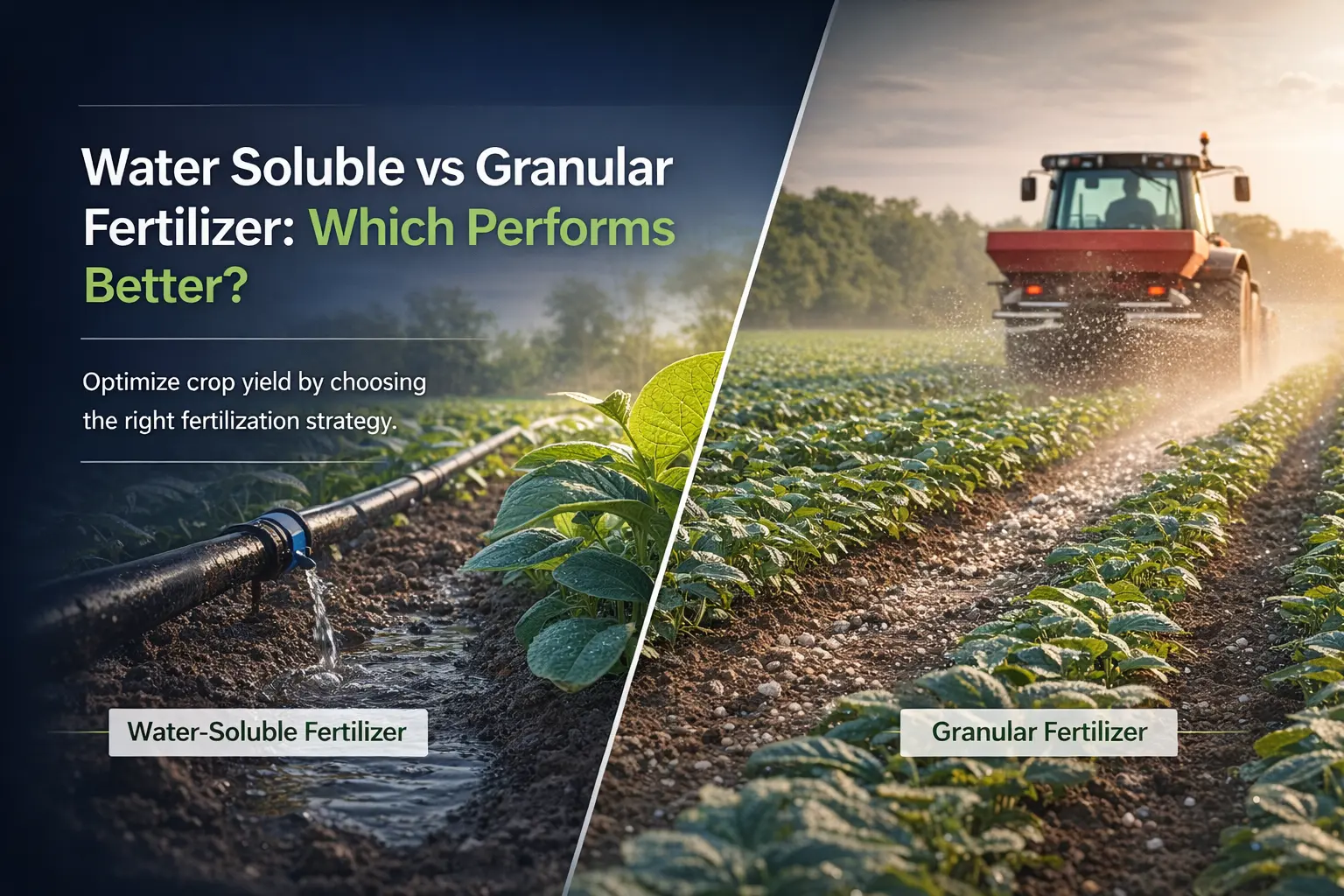
Choosing between water-soluble and granular fertilizer directly impacts crop yield, nutrient efficiency, and operational cost. Many fertilizer programs look effective on paper but underperform in the field because the product form does not match the crop stage, irrigation system, or nutrient delivery strategy.
The reason is simple: fertilizer form must align with crop stage, irrigation system, and nutrient delivery strategy. That is why the choice between water soluble vs granular fertilizer matters so much in commercial agriculture, directly influencing uptake speed, labor efficiency, and return per acre.
Water Soluble vs Granular Fertilizer – The Real Difference
The main difference between water-soluble and granular fertilizer is how quickly nutrients become available to plants. In the water soluble vs granular fertilizer comparison, water-soluble fertilizers dissolve in water and provide immediate nutrient uptake through fertigation or foliar feeding, while granular fertilizers release nutrients gradually as they break down in the soil. This makes soluble fertilizers better for rapid correction and precision feeding, and granular fertilizers more suitable for base fertilization and large-scale field application.
| Feature | Water-Soluble Fertilizer | Granular Fertilizer |
|---|---|---|
| Nutrient Availability | Immediate | Gradual |
| Application Method | Fertigation / Foliar | Broadcast / Banding |
| Precision | High | Moderate |
| Best Use | High-value crops, controlled systems | Field crops, base fertilization |
| Cost Efficiency | Higher cost, higher control | Lower cost, bulk application |
The core difference is not just how the product looks. It is how nutrients move from the fertilizer into the root zone and how quickly the crop can access them.
Water-soluble fertilizer dissolves fully or near fully in water and is typically applied through fertigation systems, foliar programs, or dissolved spray tanks. It is designed for fast nutrient availability and precise dosing. This makes it valuable when growers need to correct deficiencies quickly, support crops during peak demand, or manage nutrition in high-value systems where timing is critical.
Granular fertilizer is applied in solid form, usually through broadcast spreading, banding, and side-dressing methods, or base fertilization. Nutrients become available as granules break down with soil moisture. In many field cropping systems, this remains the most practical way to deliver larger nutrient volumes efficiently across broad acreage.
Neither option is automatically better. The right choice depends on crop type, soil condition, irrigation infrastructure, labor capacity, and the level of control required over nutrient timing.
When Water-Soluble Fertilizer Performs Better
Water-soluble products are built for control. In operations with drip irrigation, sprinkler fertigation, or intensive nutrition schedules, that control translates into better nutrient use efficiency and less guesswork, supported by findings from fertigation studies in crop production systems.
The biggest advantage is speed. Because the nutrients are already dissolved, the plant can access them quickly once they reach the root zone or leaf surface. This is especially useful during rapid vegetative growth, flowering, fruit set, or stress recovery periods when a delay in nutrition can reduce yield potential or quality.
Another advantage is precision. Water-soluble formulations allow agronomy teams to fine-tune nutrient ratios by growth stage. Nitrogen, phosphorus, potassium, calcium, magnesium, and micronutrients can be delivered in measured amounts and adjusted as crop demand shifts. For commercial growers working with high-value crops or intensive production systems, that flexibility is often worth the higher product and application management cost.
Water-soluble fertilizer also fits well where uniformity matters. In fertigation systems, nutrients can be distributed consistently across the irrigated zone, reducing the variability that sometimes comes with surface-applied granular products in dry or uneven soil conditions.
That said, water-soluble products demand infrastructure and discipline. Poor water quality, incompatible tank mixes, clogged emitters, and weak injection practices can reduce performance quickly. In large operations without reliable irrigation or application control, the theoretical benefit of solubility may not translate into a field advantage.
Where Granular Fertilizer Still Leads
Granular fertilizer remains the backbone of many commercial fertility programs for a reason. It is efficient for delivering bulk nutrients, straightforward to store and handle, and well suited to pre-plant and broad-acre application strategies.
For crops that require substantial base fertility, granular products often provide the most practical solution. They can be incorporated before planting, placed in bands for early root access, or side-dressed during crop development. In systems where fertigation is not available, granular fertilizer is usually the operational standard.
Cost structure is another factor. On a per-ton and per-acre basis, granular fertilizer can be more economical for foundational nutrient supply, especially for macronutrient-heavy programs. It also reduces dependence on injection equipment and specialized soluble formulations.
Granular products can perform very well when moisture conditions are adequate and application timing is aligned with crop demand. But the trade-off is slower nutrient release compared to soluble forms. Research has shown that the effectiveness of granular fertilizers depends heavily on their dissolution and soil interaction dynamics, particularly in relation to nutrient uptake efficiency (study on fertilizer solubility and plant uptake). If a crop is already showing deficiency symptoms, a granular correction may come too late to protect yield.
Pros and Cons of Water-Soluble vs Granular Fertilizer
Water-Soluble Fertilizer
- Fast nutrient availability
- High precision and control
- Ideal for fertigation systems
- Requires infrastructure and management
Granular Fertilizer
- Cost-effective for large areas
- Easy to store and apply
- Suitable for base fertilization
- Slower nutrient availability
Nutrient Efficiency Depends on Placement and Timing
In the water soluble vs granular fertilizer discussion, efficiency is often presented too simply. Soluble products are not always more efficient, and granular products are not always less efficient. The better question is whether the nutrient reaches the right place at the right time.
Water-soluble fertilizer tends to deliver high efficiency when used in managed irrigation systems because nutrients can be split into smaller, targeted applications. This reduces excessive loading at one time and can lower losses from leaching or fixation, particularly in sandy soils or in crops with staged nutrient demand, as demonstrated in fertigation vs granular fertilizer research. Multiple studies also confirm improvements in nutrient use efficiency under split application systems, including research on fertigation and crop productivity.
Granular fertilizer can also be highly efficient when placed correctly. Banding nutrients near the root zone, applying before rainfall or irrigation, and matching release timing to crop uptake can produce strong results. Problems usually come from poor synchronization—too much nutrient applied too early, too far from active roots, or under conditions that limit dissolution and movement.
For procurement teams and distributors, this matters because product selection should support a program, not just fill a category. A lower-cost product that misses the uptake window can be more expensive in the end than a premium formulation that improves nutrient recovery and protects yield.
Crop Type and Production System Change the Answer
There is no universal winner because different crops demand different feeding strategies.
In fertigation-based vegetable, fruit, and greenhouse systems, water-soluble fertilizer often has a clear advantage. These crops respond strongly to frequent, precise nutrition, and research on water-soluble fertilizers in horticultural crops confirms the importance of controlled nutrient delivery. Fast corrections and balanced feeding are central to maintaining yield and market quality.
In broad-acre row crops, cereals, oilseeds, and many open-field systems, granular fertilizer usually plays the larger role. The acreage scale, equipment setup, and economics favor solid applications for core nutrition. Even then, soluble products may still have a place for targeted interventions, starter programs, or micronutrient support.
Permanent crops such as orchards and vineyards often benefit from a combination approach. Granular products may support seasonal base fertility, while water-soluble fertilizers improve in-season control through irrigation. This kind of integration often produces better nutrient efficiency than relying on one format alone.
Operational Factors Buyers Should Evaluate
For professional buyers, product performance is only part of the decision. The supply chain and application model matter just as much.
Water-soluble fertilizer requires consistent formulation quality, reliable dissolution behavior, and compatibility with irrigation and spray systems. Variability in particle size, impurity levels, or solubility can create costly operational issues. That is why source reliability and manufacturing consistency are critical, particularly for distributors and commercial growers managing large-volume programs.
Granular fertilizer brings its own quality requirements. Particle uniformity, hardness, dust control, nutrient consistency, and storage stability all influence field performance and logistics efficiency. A granular product that spreads unevenly or cakes in storage can create serious losses in both labor and crop performance.
This is where working with a production-driven supplier matters more than many buyers expect. At scale, consistency is not a bonus. It is part of the agronomic result.
Recent comparative studies also show that combining fertigation and granular fertilization strategies can optimize both yield and environmental performance, depending on crop and soil conditions (recent comparative studies on fertigation and granular fertilization).
A Combined Strategy Often Delivers the Best Return
The most effective fertility programs rarely treat water-soluble and granular fertilizers as competing options. In many commercial systems, they are complementary tools.
Granular fertilizer can establish a strong nutritional foundation at planting or early growth, covering bulk nutrient demand in a cost-effective way. Water-soluble fertilizer can then refine the program during critical growth stages, respond to tissue analysis, support stress periods, or supply nutrients that need tighter timing.
This combined approach is often the strongest answer where growers need both scale and precision. It balances operational efficiency with agronomic responsiveness. It also gives distributors and procurement managers more flexibility when designing programs for different crops, climates, and irrigation systems.
For suppliers serving commercial agriculture across multiple markets, that flexibility is increasingly valuable. Buyers are not just looking for fertilizer types. They are looking for dependable product portfolios that support complete nutrition strategies under real field conditions.
Which One Should You Choose?
If the priority is fast uptake, precise dosing, and in-season nutritional control, water-soluble fertilizer is usually the better fit. If the priority is broad-acre efficiency, foundational nutrient supply, and lower-cost bulk application, granular fertilizer often makes more sense.
But the strongest answer is often more specific than that. Choose based on crop stage, irrigation capacity, soil behavior, nutrient targets, and the operational realities of your business. A fertilizer program performs best when product form, application method, and agronomic timing work together.
That is the standard commercial agriculture should demand – not just nutrients on a specification sheet, but nutrition delivered in the form that gives the crop the best chance to convert input into yield.
Frequently Asked Questions
Neither is universally better. Water-soluble fertilizers are ideal for fast nutrient uptake and precise control, while granular fertilizers are more efficient for large-scale, base nutrient applications. The best choice depends on crop type, irrigation system, and timing.
Water-soluble fertilizers can be more effective in controlled irrigation systems because they provide immediate nutrient availability and allow for precise dosing. However, effectiveness depends on proper application and crop needs.
Granular fertilizer is best used for pre-plant or early-stage applications where bulk nutrients are needed. It works well in field crops and systems without fertigation infrastructure.
Yes, many commercial growers use a combined strategy. Granular fertilizers provide base nutrition, while water-soluble fertilizers fine-tune nutrient delivery during critical growth stages.