
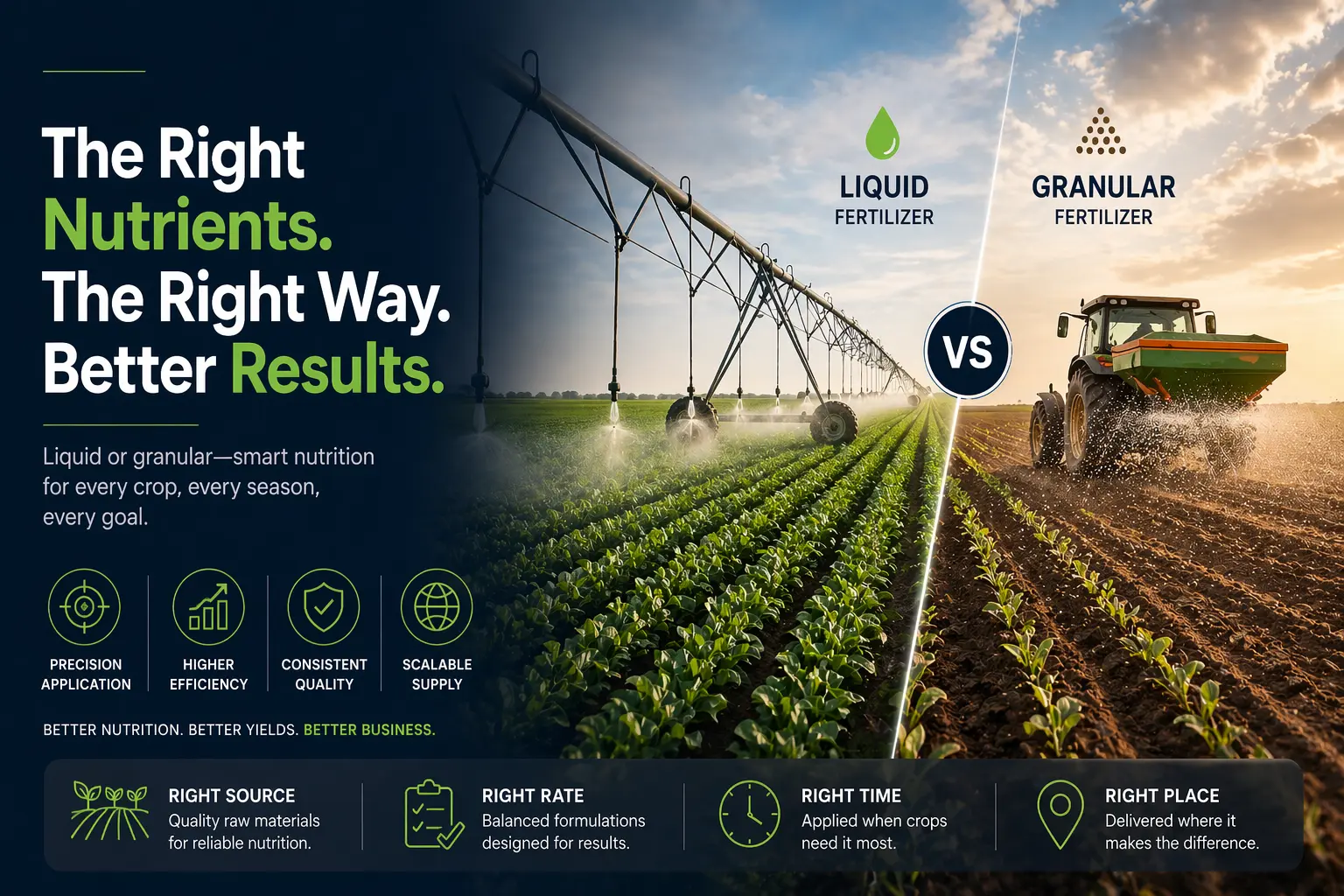
A wheat grower correcting a sulfur deficiency mid-season has a very different decision to make than a distributor planning preseason NPK supply for broad-acre crops. That is why liquid fertilizer vs granular is not a simple preference question. It is an operational decision that affects nutrient efficiency, logistics, application timing, storage, and ultimately margin per acre.
For professional buyers and commercial growers, the right choice depends less on format alone and more on how that format performs under real field conditions. Crop stage, equipment, soil behavior, climate risk, labor availability, and blending flexibility all matter. In many operations, the best answer is not liquid or granular. It is knowing where each format creates the strongest agronomic and commercial return.
In practice, field observations across multiple cropping systems show that fertilizer performance can vary significantly depending on placement method and timing, even when total nutrient rates remain constant. This aligns with agronomic research indicating that nutrient use efficiency (NUE) is strongly influenced by application strategy rather than product form alone.
Liquid fertilizer vs granular: the real difference
| Factor | Liquid Fertilizer | Granular Fertilizer |
|---|---|---|
| Nutrient availability | Fast (immediate or near-immediate) | Slower (requires dissolution) |
| Application precision | High (fertigation, foliar) | Moderate (depends on spreader calibration) |
| Uniformity | Very uniform | Can vary if spreading is uneven |
| Logistics | Requires tanks, pumps, infrastructure | Easy storage and transport |
| Cost structure | Higher per ton, higher efficiency potential | Lower per ton, strong bulk economics |
| Best use case | Precision, fertigation, correction | Base fertilization, large acreage |
At the most basic level, liquid fertilizers deliver nutrients in dissolved or suspended form, while granular fertilizers deliver nutrients as dry particles that break down after application. That difference changes how nutrients move, how fast they become available, and how precisely they can be applied.
Liquid products are often selected when speed, uniformity, and compatibility with fertigation or foliar systems matter most. They fit well in high-value cropping systems, precision programs, and situations where a fast correction is needed. Granular products remain the backbone of broad-acre fertility because they are efficient to store, straightforward to spread, and highly practical for large-volume base applications.
Neither format is automatically superior. Performance depends on the nutrient source, formulation quality, application method, and the field conditions at the time of use. Soil science research shows that soil properties such as CEC, moisture, and placement depth often influence nutrient availability as much as fertilizer type.
When liquid fertilizer has the advantage
Liquid fertilizers are valued for fast delivery and placement control. In fertigated systems, they allow nutrients to be applied close to crop demand, which can improve uptake efficiency and reduce unnecessary losses from over-application. For crops with clear stage-specific nutritional needs, this flexibility is a major advantage.
They also support uniform application. A well-formulated liquid can be distributed consistently across the field or through irrigation systems, helping avoid the variability that sometimes appears with uneven dry spreading. For micronutrients and specialty nutrition, liquid formats are often the most practical choice because they make targeted, low-dose application easier.
Speed matters in corrective nutrition. If a crop is showing visible deficiency and weather or growth stage leaves little room for delay, liquid application can respond faster than waiting for a granular product to dissolve and move into the root zone. Research shows that liquid-applied nutrients can improve short-term uptake efficiency.
There are trade-offs. Liquid products require tanks, pumps, compatible equipment, and disciplined handling. Transport economics can also be less favorable when moving water-based products over long distances compared with concentrated dry materials.
Best-fit scenarios for liquid fertilizers
Liquid fertilizers tend to perform best where precision and timing carry a premium. Fertigation programs, starter applications, foliar feeding, and in-season corrections are common examples. They are also useful in integrated nutrition strategies where multiple nutrients need to be delivered in a controlled, repeatable way.
For distributors and procurement teams, liquid fertilizers can add value when the market demands specialty products, rapid crop response, or water-soluble compatibility. The key is product stability, formulation consistency, and dependable supply.
Where granular fertilizer remains the stronger option
Granular fertilizer continues to dominate large-scale agriculture for one reason above all others – it is operationally efficient. It stores well, moves well, and fits established application systems across major row crops and field crops. When the goal is to deliver substantial nutrient volume across large acreage at the right cost per ton, granular products are often the most practical solution.
Granular fertilizers are especially effective for preseason and base fertilization. They allow operations to apply major nutrients in bulk before planting or at key soil preparation stages. For phosphorus and potassium programs, granular forms are frequently preferred because they are easy to handle and integrate into broad fertility plans.
Another advantage is concentration. Dry fertilizers often provide more nutrient per unit of transported weight than many liquid formulations. For export-oriented supply chains and wholesale distribution, that can improve freight efficiency and warehousing economics.
The limitation is responsiveness. Granular fertilizers depend on soil moisture and dissolution before nutrients become fully available. In dry conditions, that can slow performance. Studies show that efficiency varies depending on timing and moisture.
Best-fit scenarios for granular fertilizers
Granular products are a strong fit for broad-acre nutrient programs, bulk blending, and situations where growers need reliable tonnage at scale. They work well for foundational soil fertility, especially when applications are planned ahead of crop demand and supported by predictable moisture conditions.
For wholesalers, importers, and private label buyers, granular fertilizers often provide strong commercial efficiency due to storage simplicity, shipping density, and broad market acceptance.
Application method changes the answer
Many fertilizer comparisons stop at product form, but application system is often the deciding factor. A liquid fertilizer can outperform a granular one in a fertigated vegetable program, while the same liquid may offer little advantage in a dryland cereal system with limited injection infrastructure.
If the farm uses center pivot irrigation, drip systems, or high-precision sprayers, liquids may fit naturally into the operation. If the business relies on spreaders, bulk tenders, and large seasonal applications, granular formats may offer better throughput and lower operational friction.
This matters for B2B buyers as much as growers. Product demand is shaped by what customers can apply efficiently. A fertilizer that looks strong on paper may underperform commercially if it does not match the equipment base in the market.
Cost is not just product price
| Cost Factor | Liquid | Granular |
|---|---|---|
| Product price | Higher | Lower |
| Transport | Less efficient | More efficient |
| Application cost | Higher | Lower |
| Nutrient efficiency | Potentially higher | Moderate |
| Total ROI | High in precision systems | High in bulk systems |
There is also a risk cost. Poor timing, uneven distribution, or delayed nutrient availability can reduce yield potential. Research confirms that inefficient nutrient management reduces productivity.
Product quality matters more than format alone
A low-quality liquid with poor stability or compatibility can create serious operational issues. A low-quality granular product with inconsistent particle size or weak hardness can lead to segregation, dust, uneven spreading, and performance variability. Format does not compensate for poor manufacturing.
This is where producer capability matters. Consistent raw materials, controlled formulation, and dependable production standards have a direct effect on field performance and supply reliability.
Fertilizer efficiency research confirms that product quality directly impacts results.
FERTIZER’s approach reflects this reality by focusing on production-driven supply, formulation quality, and scalable fertilizer solutions that support both agronomic performance and procurement confidence.
How to choose the right format for your operation
Start with the crop system and the timing of nutrient demand. If the program requires precise in-season delivery, rapid correction, or fertigation compatibility, liquid fertilizers often offer a stronger fit. If the priority is large-volume base nutrition with efficient transport and application across extensive acreage, granular fertilizers usually deliver better operational value.
Then look at infrastructure. The best product is the one the farm or distribution network can store, move, and apply without friction. After that, compare nutrient concentration, compatibility with other inputs, expected efficiency under local soil and moisture conditions, and the reliability of the supplier.
The strongest fertilizer strategy is rarely built around a single format. Many successful commercial programs use granular products for foundational fertility and liquid products for precision feeding, micronutrients, or in-season correction.
The useful question is not which format wins in general. It is which format helps your business deliver healthier crops, better nutrient efficiency, and more dependable results under actual operating conditions.