
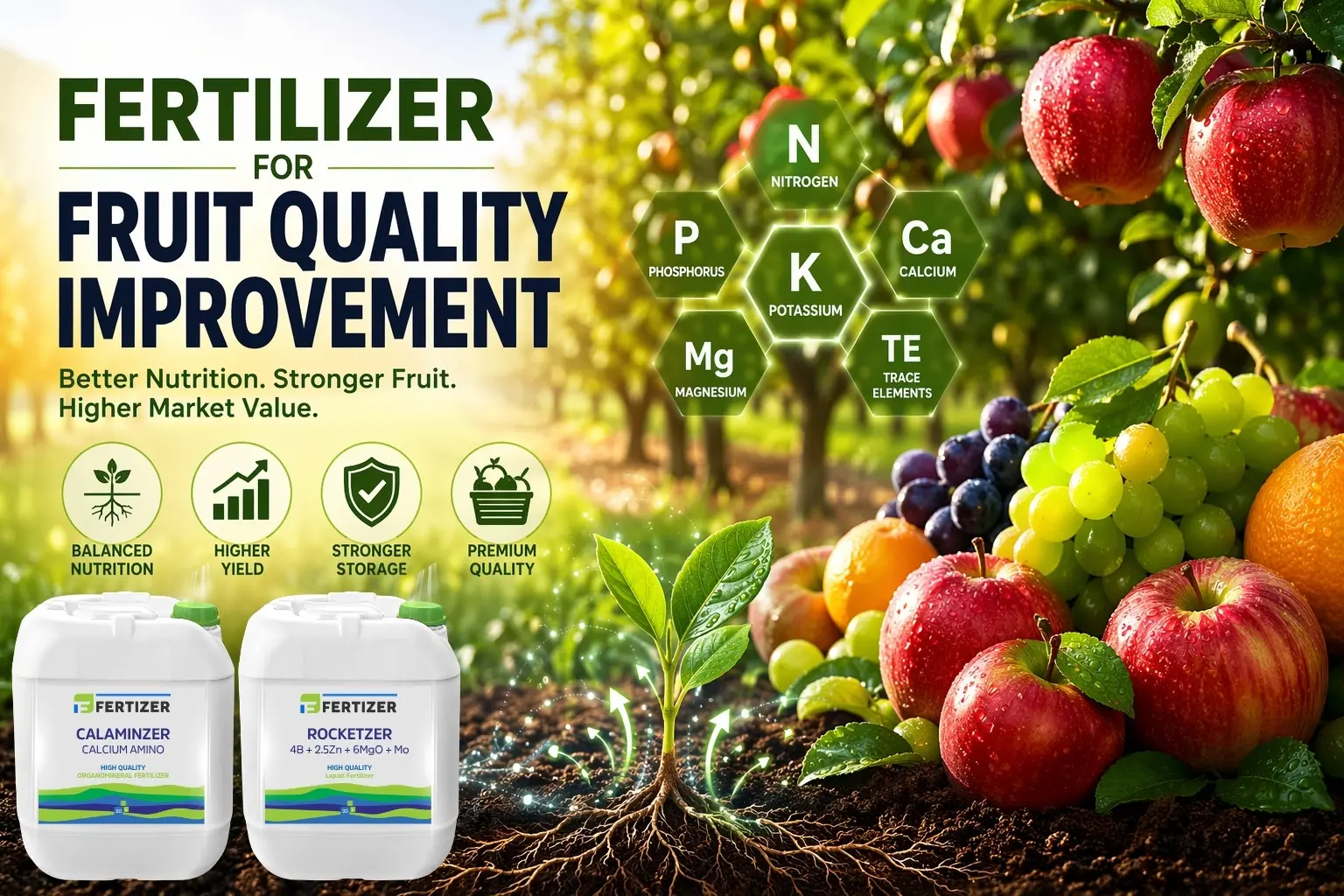
Fruit that misses grade by a small margin still carries the full cost of production. A block can yield well and still underperform commercially if color is weak, firmness drops too fast, sugars do not develop evenly, or finish is inconsistent. That is why fertilizer for fruit quality improvement is not a side issue in commercial production. It is a margin issue tied directly to packout, shelf life, transport performance, and buyer acceptance.
Quality is built over the season, not added at the end. Nutrition has to support canopy efficiency, root activity, flowering, fruit set, cell division, cell expansion, and late-stage ripening without pushing the crop into excessive vegetative growth. The right fertilizer program does more than feed the plant. It helps direct nutrients at the right time, in the right form, and in the right balance so fruit reaches market with stronger commercial value.
What fruit quality actually depends on
In practical terms, fruit quality means a combination of size, uniformity, color, firmness, sugar development, dry matter, skin finish, storability, and resistance to physiological stress. The exact priority depends on the crop and market channel. Export fruit often needs firmness and shelf life first. Processing crops may prioritize solids and uniform maturity. Fresh domestic channels may reward appearance and flavor more heavily.
This is where many nutrition programs lose efficiency. They focus on total yield, often with aggressive nitrogen inputs, but do not adjust the program for the quality targets that drive final returns. High fruit load, poor calcium movement, excess vegetative vigor, or unbalanced potassium can all reduce fruit quality even when tissue tests show acceptable overall nutrition.
A strong program starts with one basic principle – fruit quality responds to balanced nutrition, not isolated inputs. Nitrogen, phosphorus, potassium, calcium, magnesium, sulfur, and trace elements all affect fruit development differently, and their timing matters as much as their rate.
From a technical perspective, balanced nutrition strategies are also supported by international agronomic frameworks. According to FAO soil and plant nutrition guidelines, nutrient balance particularly between potassium and calcium, plays a critical role in fruit firmness, storability, and overall market quality.
How fertilizer for fruit quality improvement works in the field
The role of fertilizer for fruit quality improvement is to support the plant through each physiological stage without creating new limitations. Early in the season, nutrition affects root growth, flowering strength, and fruit set potential. During fruit development, nutrient balance influences cell division and fruit sizing. Closer to maturity, the program must support sugar movement, color expression, firmness, and storage quality.
Nitrogen is the clearest example of trade-offs. Too little nitrogen reduces canopy function, weakens photosynthesis, and limits fruit size. Too much nitrogen, especially in readily available forms late in the cycle, can delay maturity, soften fruit, suppress color, and push excessive vegetative growth that competes with fruit for assimilates. For quality-focused production, nitrogen must be managed with precision rather than volume.
Potassium is central to fruit filling, sugar transport, water regulation, and overall market finish. In many fruit crops, potassium demand rises sharply during development and maturation. But the source matters. Chloride-sensitive crops may respond better to sulfate- or nitrate-based potassium sources, particularly where salinity is already a concern. The cheapest source is not always the most efficient one when quality premiums are at stake.
Calcium is equally critical, especially for firmness, cell wall strength, shelf life, and reduction of storage-related disorders. The challenge with calcium is not only total supply in the soil. It is movement within the plant. Calcium transport depends heavily on transpiration, root health, and competition from other cations. A soil can test adequately for calcium while fruit still develops internal deficiency symptoms. That is why calcium planning usually needs both root-zone strategy and targeted foliar support.
Field observations from commercial production
In commercial fruit production systems, small adjustments in nutrient timing often translate directly into measurable quality gains. For example, in apple orchards targeting export markets, reducing late-season nitrogen applications by 20–30% while increasing calcium inputs during the final 4–6 weeks before harvest has been associated with improved firmness and reduced storage disorders.
Similarly, in high-yield citrus production, potassium demand can increase significantly during fruit enlargement stages. Programs that adjust potassium supply during this period often achieve more uniform sizing and better color development compared to flat-rate fertilization strategies.
These examples highlight a consistent pattern: fruit quality responds more to timing and balance than to total nutrient volume.
Matching nutrient timing to fruit development
A quality-driven fertilizer strategy changes as the crop moves through the season. The best results usually come from staged feeding rather than a flat, repeated program.
Early growth and fruit set
At the start of the cycle, the goal is to establish a healthy canopy and active root system without forcing lush growth. Phosphorus supports early energy transfer and root development, while moderate nitrogen and key micronutrients help flowering and fruit set. Zinc and boron are especially relevant in reproductive stages because they influence pollen viability, fertilization, and early fruit retention.
If the crop enters fruit set under nutrient stress, later correction often improves yield less than expected and rarely restores full quality potential. Early deficiencies tend to reduce uniformity, which then creates grading problems at harvest.
Fruit sizing and cell expansion
Once fruit is set, nutrient demand shifts. Potassium becomes more prominent, supported by sufficient nitrogen, magnesium, and trace elements that maintain photosynthetic activity. During this stage, organomineral and water-soluble formulations can be useful because they improve nutrient availability while allowing more accurate adjustments through fertigation or foliar feeding.
This is also the period when overcorrection becomes expensive. Heavy nitrogen to chase larger fruit may increase size in some situations, but it can reduce firmness and delay finish. It depends on crop type, vigor, irrigation conditions, and market target. Quality programs work best when sizing is supported without losing structural integrity.
Maturity, color, and postharvest performance
As harvest approaches, nutrient management should help the crop finish cleanly. Potassium remains important for sugar accumulation and color development, while calcium supports firmness and storability. Late nitrogen usually needs tighter control. In some crops, excessive late nitrogen leads to softer fruit, weaker color, and shorter shelf life.
Micronutrients also matter here. Magnesium helps maintain chlorophyll and photosynthetic efficiency. Boron supports sugar transport and reproductive tissue function. Iron, manganese, and zinc influence enzyme activity and overall plant metabolism. Deficiencies may not always show dramatic visual symptoms, yet they can still reduce packout and consistency.
Choosing the right fertilizer types for better fruit quality
There is no single product that fits every orchard, vineyard, or fruit field. Crop stage, irrigation system, soil chemistry, climate, and logistics all influence the best choice. For commercial operations, the question is less about finding one ideal fertilizer and more about building a compatible product system.
Water-soluble NPK fertilizers are valuable where precision feeding is needed through fertigation. They allow fast correction and stage-specific nutrient ratios, which is especially useful in high-value fruit production. Liquid fertilizers can serve the same purpose when rapid uptake and easy tank integration are priorities.
Organomineral fertilizers can add value where soil structure, nutrient buffering, and root-zone biology are limiting quality performance. In low-organic-matter soils, they often help improve nutrient retention and overall crop resilience. That benefit may not show up as a dramatic short-term response in every season, but it can support more stable fruit quality over time.
Micronutrient products and specialty formulations are often the difference between acceptable quality and premium quality. That is particularly true in crops with known calcium sensitivity or where boron, zinc, or magnesium deficiencies are common. Foliar applications can be effective, but they work best as part of a planned program rather than a rescue treatment after quality has already slipped.
Why soil and water conditions can override a good formula
Even a well-designed fertilizer program can underdeliver if the root environment is working against it. High salinity, poor drainage, compaction, extreme pH, bicarbonates in irrigation water, or low organic matter all reduce nutrient efficiency. In these conditions, growers often respond by increasing rates. That can raise costs without fixing the actual bottleneck.
For example, calcium-related disorders in fruit crops are frequently tied to water movement and plant stress, not just low calcium supply. Potassium uptake can be reduced by cation imbalance. Micronutrients may be present in the soil but chemically unavailable at high pH. This is why quality-focused nutrition should be based on both soil and tissue data, combined with field observation and crop history.
For distributors, importers, and procurement teams, this has a clear implication. Product consistency matters, but formulation flexibility matters too. Commercial buyers need access to fertilizer categories that can adapt to different regional conditions and crop systems, not a one-size-fits-all offer.
Building a commercially stronger nutrition program
A practical program for fruit quality improvement usually combines base fertility with stage-specific correction. Broadly speaking, that means establishing a reliable foundation in the root zone, then using soluble, liquid, or foliar inputs to manage peak demand periods and prevent hidden deficiencies.
The strongest results typically come from programs built around measurable outcomes: firmer fruit, better color, more uniform sizing, stronger dry matter, lower rejection rates, and improved storage performance. Those are commercial indicators, not just agronomic ones. They matter to growers, packers, exporters, and every buyer responsible for consistent market supply.
For this reason, supply reliability should not be treated as separate from crop performance. A quality program only works if the inputs arrive on time, perform consistently, and match the required analysis from one shipment to the next. That is where working with a production-driven supplier such as FERTIZER can support more stable planning across seasons and markets.
As a manufacturer supplying fertilizer solutions to international markets, FERTIZER focuses on consistent nutrient formulations designed for commercial fruit production systems. Product consistency, supply reliability, and formulation flexibility are critical factors for distributors and growers operating across different climate and soil conditions.
Fruit quality is rarely improved by pushing harder. It improves when nutrition is more precise, more balanced, and more aligned with the crop’s real development pattern. The operations that treat fertilizer as a quality tool, not just a yield input, are usually the ones that protect margin more effectively when market standards tighten.
Practical note
Fertilizer strategies should always be adapted based on soil analysis, tissue testing, irrigation quality, and local agronomic conditions. Programs that perform well in one region or crop system may require adjustment under different environmental or management constraints.
Frequently Asked Questions (FAQ)
There is no single most important nutrient. Fruit quality depends on balanced nutrition, but potassium and calcium are particularly critical for size, sugar transport, firmness, and shelf life.
Excess nitrogen, especially late in the season, can reduce fruit firmness, delay maturity, and negatively affect color development. Proper timing is more important than total nitrogen volume.
Potassium supports sugar movement, water regulation, and fruit filling. Adequate potassium during fruit development improves size uniformity, color, and overall market appearance.
Calcium strengthens cell walls and improves tissue stability. Poor calcium distribution within the plant can lead to soft fruit and storage-related disorders, even when soil calcium levels are sufficient.
Fertilizer programs should be adjusted throughout the season. Early stages focus on root and flower development, while later stages prioritize fruit sizing, color, firmness, and postharvest performance.