
A crop rarely sends an early warning in plain terms. What shows up first is slower growth, uneven color, weak rooting, poor flowering, lower fruit set, or reduced uniformity across the field. By the time these symptoms are visible, stress has already started to limit nutrient uptake and crop performance, as shown in research on drought and salinity effects on plant nutrition (Hu & Schmidhalter, 2005). That is why choosing the right fertilizer for plant stress is not simply a corrective input decision. It is a yield protection strategy.
For commercial growers and professional buyers, the real question is not whether stress occurs. It does – through heat, drought, salinity, transplant shock, waterlogging, nutrient imbalance, or rapid vegetative demand. The better question is which fertilizer programs help crops maintain metabolic activity, root function, and recovery speed when conditions are working against them.
Best fertilizer for plant stress (quick answer)
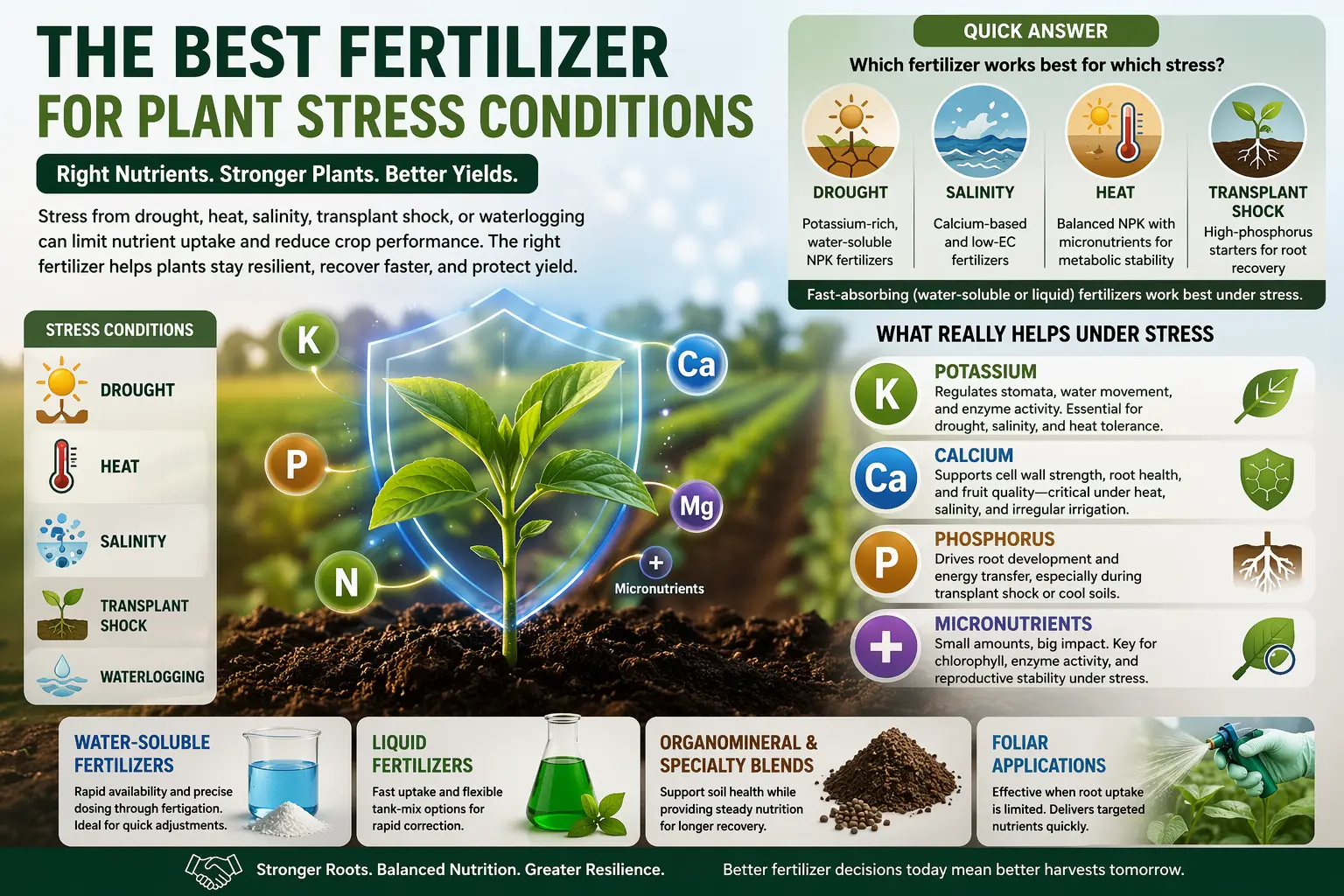
The best fertilizer for plant stress is typically a fast-absorbing, balanced or targeted nutrient solution that matches the type of stress and crop stage.
- Drought stress: Potassium-rich, water-soluble NPK fertilizers to support water regulation and stomatal control
- Salinity stress: Calcium-based and low-EC fertilizers to reduce sodium interference and maintain nutrient balance
- Heat stress: Balanced NPK with micronutrients to avoid excessive vegetative growth and support metabolic stability
- Transplant shock: High-phosphorus starters to promote root development and early recovery
Fast-absorbing formulations such as water-soluble or liquid fertilizers are typically more effective under active stress conditions.
What plant stress does to fertilizer performance
Stress changes the way plants absorb and use nutrients. In normal conditions, roots explore soil efficiently, transpiration drives nutrient flow, and leaves convert nutrients into biomass with relatively predictable efficiency. Under stress, that system becomes less stable.
In commercial production systems, this shift is often visible within a short time. For example, in drip-irrigated vegetable crops under heat and water stress, growers frequently observe uneven nutrient uptake patterns across the field, even when the base fertilization program remains unchanged. This highlights how stress disrupts not only plant physiology but also nutrient efficiency.
Drought reduces mass flow of nutrients to the root zone and often limits uptake of potassium, calcium, and magnesium, a pattern widely documented in plant nutrition research (Waraich et al., 2011). Waterlogging can reduce oxygen availability, suppress root respiration, and increase nutrient loss. Heat stress accelerates plant metabolism, but not always in a productive direction. Salt stress interferes with water movement and can create direct competition between sodium and essential nutrients like potassium and calcium.
This is where many standard fertilizer programs fall short. A formula designed for ideal uptake conditions may not perform well when root activity is restricted or when rapid correction is needed. In stressed crops, fertilizer efficiency matters as much as nutrient content.
Fertilizer for plant stress: what actually helps
The best fertilizer for plant stress depends on the type of stress, the crop stage, the soil or substrate condition, and how quickly the crop needs support. There is no single formula that solves every situation. However, the most effective products usually share a few characteristics.
Effective fertilizers supply nutrients in forms the plant can absorb quickly. They prioritize elements linked to osmotic balance, root activity, cell wall strength, and recovery. Compatibility with existing application systems is equally important, whether through fertigation, foliar feeding, base fertilization, or a combination of methods.
Water-soluble NPK fertilizers are often a strong option during active stress management because they allow precise application and rapid availability. Liquid fertilizers can be equally effective where fast delivery and tank-mix flexibility are priorities. In longer-cycle recovery programs, organomineral and specialty formulations can support soil function while maintaining nutrient supply.
Potassium is often central
When crops are exposed to drought, salinity, temperature swings, or heavy fruit load, potassium usually becomes a key part of the conversation. It helps regulate stomatal function, water movement, and enzyme activation, and plays a central role in plant stress tolerance (Cakmak, 2005). A crop that is marginal in potassium is typically less resilient under pressure.
That said, potassium should not be applied in isolation without checking balance. Excess potassium can suppress calcium or magnesium uptake in some systems. For high-value crops under repeated stress cycles, nutrient ratios matter.
Calcium supports structural stability
Calcium is less mobile in the plant, which makes timing critical. During periods of rapid growth, heat, or inconsistent irrigation, calcium-related disorders often become more visible. Adequate calcium supports cell wall integrity, root health, and tissue quality, but the delivery method must match the crop’s uptake conditions.
If root uptake is compromised, relying only on soil-applied calcium may not be enough. In those situations, targeted foliar strategies may have a place, especially in crops where fruit or leaf quality drives market value.
Phosphorus matters most when roots are under pressure
Stress frequently reduces root vigor first. When roots slow down, phosphorus efficiency becomes more important because it supports energy transfer and root development under stress conditions (Khan et al., 2023). This is especially relevant in cool soils, compacted conditions, or after episodes of waterlogging.
High-phosphorus starters or balanced soluble formulas can help, but oversupplying phosphorus later in the cycle may not add value. The right program changes as the crop moves from establishment to recovery and then back to productive growth.
Micronutrients are small in volume, big in impact
Research and field observations consistently show that micronutrient availability plays a critical role in stress response, particularly in maintaining chlorophyll production, enzyme activity, and reproductive stability under adverse conditions.
Iron, zinc, manganese, boron, and molybdenum are often where hidden inefficiencies start. Under stressful conditions, micronutrient shortages can intensify chlorosis, poor flowering, weak pollination, and reduced metabolic function. These deficiencies are not always caused by low total nutrient levels in the soil. Often, they are caused by poor availability due to pH, salinity, antagonism, or root damage.
Chelated micronutrients and well-formulated specialty blends are particularly useful where precision and compatibility are required. For distributors and procurement teams, consistency in micronutrient quality is not a minor detail. It directly affects field response.
Matching the product to the stress scenario
Not all stress should be treated the same way, and this is where product selection becomes more technical.
In drought-prone systems, a fertilizer program should support root strength, water-use efficiency, and potassium status without creating unnecessary salt pressure in the root zone. Highly soluble products with controlled application rates are usually a better fit than heavy inputs that raise osmotic stress.
In saline environments, the goal shifts toward nutrient forms and application strategies that minimize antagonism and help maintain calcium and potassium uptake. A high-analysis fertilizer may look efficient on paper, but if it worsens root-zone salinity, the result can be lower performance rather than improvement.
In heat stress conditions, crops often need balanced nutrition rather than aggressive nitrogen. Excess nitrogen can push soft vegetative growth that becomes more vulnerable under high temperatures. Stable potassium, calcium, magnesium, and micronutrient support often delivers better results.
After transplant shock, rooting and early metabolic recovery become the priority. That usually means accessible phosphorus, moderate nitrogen, and selected micronutrients rather than high bulk feeding. In these situations, timing is often more valuable than volume.
In practice, growers who adjust fertilizer strategies based on stress conditions often achieve more stable yields compared to those using fixed programs. For instance, shifting to potassium-supported fertigation during drought periods or prioritizing calcium under salinity pressure can make a measurable difference in crop uniformity and quality.
Why fertilizer form matters under stress
When plants are under pressure, the form of the fertilizer can influence outcomes almost as much as the analysis.
Water-soluble fertilizers are valuable where fertigation systems allow precise dose management. They suit high-efficiency production because rates can be adjusted quickly as field conditions change. Liquid fertilizers offer operational speed and good uniformity, especially in intensive systems where quick correction is needed.
Organomineral fertilizers bring a different advantage. They are not the fastest emergency tool, but they can improve nutrient retention, root-zone biology, and soil condition over time. In stressed soils with low organic matter or weak structure, that longer-term benefit should not be underestimated.
Specialty products, including micronutrient packages and stress-support formulations, work best when integrated into a wider nutrition program. They are rarely a replacement for sound base fertility. They are performance enhancers when used with a clear agronomic purpose.
Procurement considerations for professional buyers
For importers, distributors, and large-scale growers, selecting fertilizer for plant stress is not just about label claims. It is about repeatable field performance, manufacturing consistency, and supply reliability.
A stress-management product that performs well in one shipment and inconsistently in the next creates risk across the chain. Solubility, raw material quality, particle uniformity, contamination control, and formulation stability all affect results in commercial agriculture. This is why producer capability matters. Manufacturers with integrated sourcing and in-house production are generally better positioned to maintain consistency across volume orders.
Portfolio breadth also matters. Stress conditions vary by crop, region, irrigation system, and season. Buyers often need more than one product type to build an effective program – for example, a base NPK, a calcium solution, and a micronutrient package. Working with a supplier that can support those needs at scale reduces operational friction and helps standardize performance.
As a manufacturer focused on export-oriented fertilizer solutions, FERTIZER works closely with distributors, importers, and commercial growers across multiple regions, gaining direct field insight into how crops respond to stress under varying climate, soil, and irrigation conditions.
FERTIZER supports this need with a broad portfolio of water-soluble, liquid, organomineral, organic, and specialty fertilizer solutions designed for consistent performance in commercial agriculture and export supply chains.
A stronger approach than reactive correction
The strongest fertilizer strategy for plant stress starts before visible damage appears. Crops under predictable pressure need preventive nutrition, not only rescue treatments. That means building programs around root development, balanced nutrient ratios, efficient delivery systems, and field-specific risk factors.
It also means accepting a practical reality. No fertilizer can cancel out poor irrigation management or prolonged environmental stress, as widely discussed in plant stress physiology literature (Farooq et al., 2009). But the right formulation can reduce the physiological cost of stress, improve nutrient efficiency when uptake is less than ideal, and help the crop return to productive growth faster.
However, well-designed fertilizer programs can significantly reduce the negative impact of stress by improving nutrient availability, supporting physiological stability, and accelerating recovery once conditions improve.
For commercial agriculture, that difference is significant. Better stress tolerance does not just protect plant health. It protects packout, uniformity, yield stability, and return on every acre.
If a crop is likely to face pressure this season, the better move is not waiting for visible decline. It is choosing a fertilizer program built to perform when conditions are less than ideal.
For growers and distributors looking to build reliable stress-management programs, choosing the right fertilizer partner is as important as selecting the right formulation.