
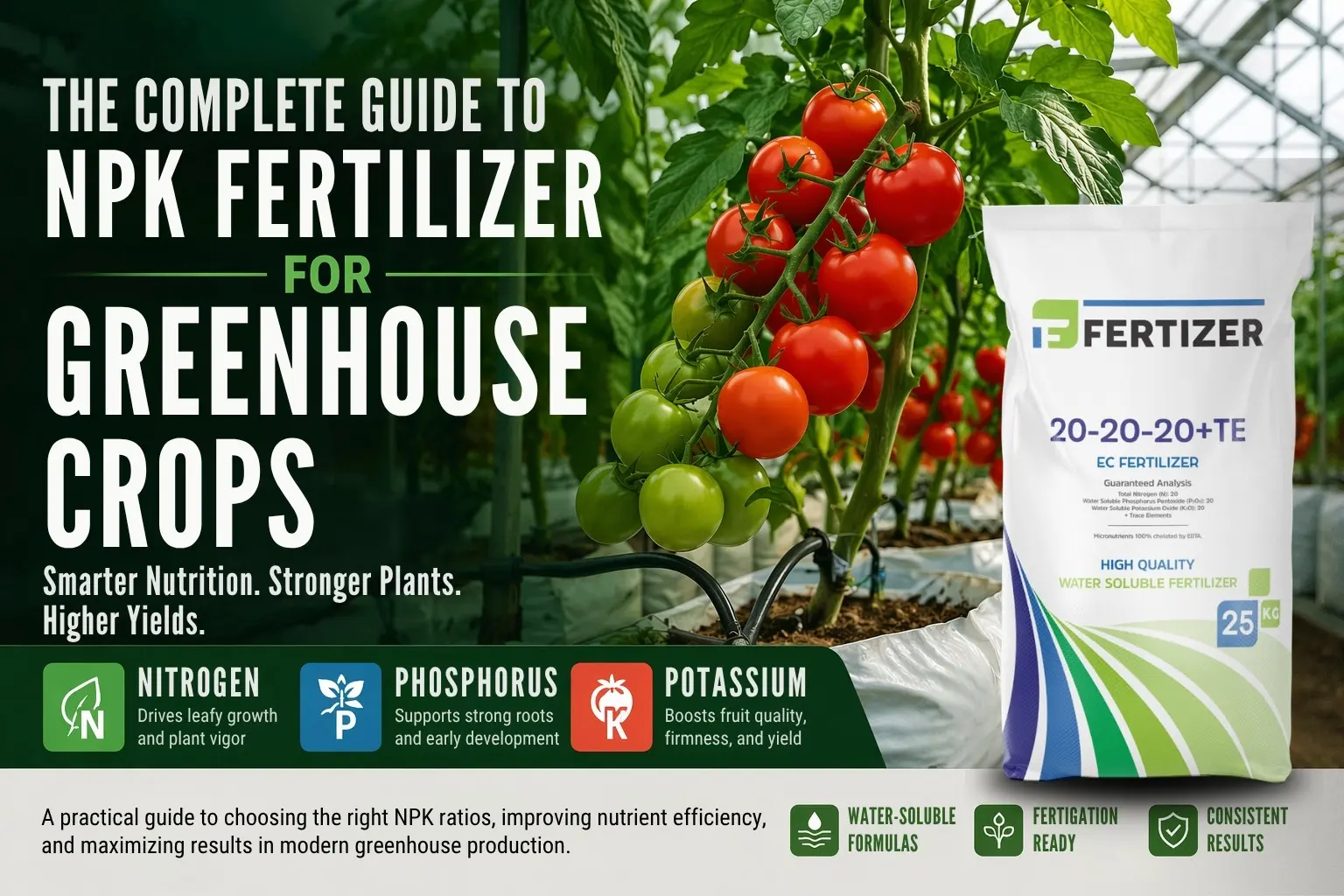
Greenhouse margins are often won or lost in the root zone. When irrigation, climate control, and crop scheduling are tightly managed, nutrition becomes one of the few variables that can still push yield, quality, and pack-out higher. That is why npk fertilizer for greenhouse crops is not just a basic input decision. It is a performance decision that affects vegetative balance, flowering strength, fruit set, uniformity, and nutrient efficiency across the entire production cycle.
Protected cultivation creates a highly controlled environment, but it also raises the cost of mistakes. Overfeeding nitrogen can drive excessive canopy growth and softer tissue. Underfeeding potassium can reduce fruit firmness, color development, and shelf life. Weak phosphorus availability can limit root expansion and early establishment, especially during transplant stages. In greenhouse systems, where every square foot is expected to perform, the NPK program needs to be precise.
Why NPK fertilizer for greenhouse crops needs a different approach
Field nutrition programs do not always translate well to greenhouse production. In open-field conditions, nutrient release and movement are influenced by rainfall, wider rooting zones, and greater buffering capacity in the soil. In a greenhouse, root volume is often restricted, irrigation is frequent, and crop demand changes quickly in response to temperature, light intensity, and production targets.
This means the fertilizer strategy must match both the crop and the system. Tomatoes grown in substrate, cucumbers in coco coir, peppers in soil beds, leafy greens in fertigation lines, and berries under protected cultivation all respond differently to nutrient concentration and timing. The best results usually come from water-soluble formulations with predictable availability and clean dissolution, especially where injectors, tanks, and drip systems are part of daily operations.
The practical advantage of a well-formulated NPK product is control. Growers and procurement teams can align nutrient ratios with crop stage, correct imbalances faster, and maintain more uniform feeding across large-scale greenhouse blocks. For commercial operations, that consistency matters as much as the nutrient analysis itself.
Understanding the role of nitrogen, phosphorus, and potassium
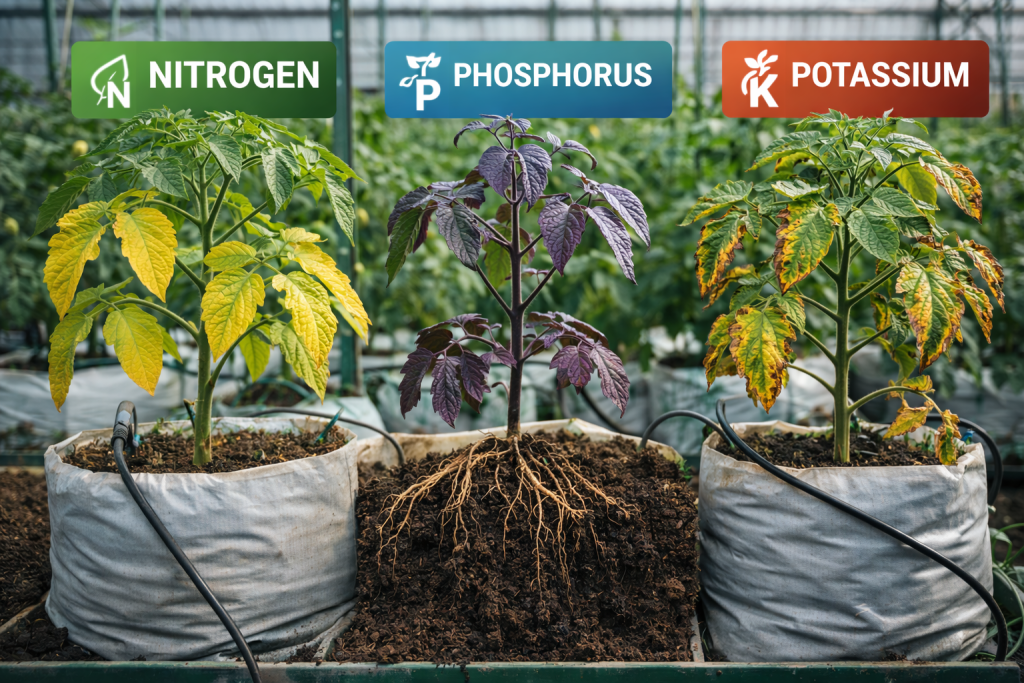
Nitrogen drives vegetative growth, leaf expansion, chlorophyll formation, and overall canopy development. In greenhouse crops, this is essential early in the cycle, but excess nitrogen can quickly become expensive. Plants may look vigorous while shifting too much energy into foliage rather than reproductive growth. In fruiting crops, this often leads to delayed flowering, weaker fruit set, and softer fruit. In commercial greenhouse conditions, excessive nitrogen is often associated with reduced fruit set efficiency as plant energy shifts toward vegetative growth rather than reproductive development.
Phosphorus supports root activity, energy transfer, and early plant establishment. It is especially important after transplanting and during periods when strong root recovery is needed. In cool root-zone conditions, phosphorus uptake can become less efficient, even when the nutrient is technically present. That is one reason formulation quality and solubility matter in protected systems.
Potassium is heavily tied to crop quality, supporting water regulation, stress tolerance, sugar movement, fruit filling, firmness, and color development. As crops move from vegetative growth into flowering and harvest, potassium becomes increasingly important, especially in high-value greenhouse production. During these stages, many growers prefer chloride-free potassium sources such as potassium sulphate to protect crop quality and avoid salinity-related stress. In commercial greenhouse tomato production, potassium-dominant feeding during fruiting stages has been shown to improve fruit firmness and post-harvest shelf life under controlled conditions.
What is the best NPK fertilizer for greenhouse crops?
The best NPK fertilizer for greenhouse crops depends on crop type and growth stage. Early stages typically require balanced or phosphorus-supported formulas, while flowering and fruiting stages benefit from higher potassium ratios to improve yield and quality. Water-soluble NPK fertilizers designed for fertigation systems generally provide the most consistent and efficient results in greenhouse production.
There is no single ratio that fits every greenhouse crop. The right choice depends on crop type, production stage, growing medium, irrigation frequency, and target outcome. A leafy crop grown for fast biomass production will not need the same nutritional profile as a long-cycle tomato crop managed for fruit quality and extended harvest.
In practice, many greenhouse operators initially rely on a single balanced formula, but over time shift toward stage-based nutrition after observing variability in fruit quality and plant response. This transition often marks a turning point in achieving consistent yield and uniform crop performance.
During propagation and early vegetative growth, balanced or slightly phosphorus-supported formulas are often useful because they promote root development and uniform establishment. Once the canopy is formed, many crops benefit from a more balanced nitrogen supply to sustain healthy growth without overstimulation. As flowering and fruiting intensify, higher potassium formulations often become more effective for quality and marketable yield.
This is where many procurement decisions become too simplified. Buying only on headline analysis can create problems if the formulation does not match the production phase. A 20-20-20 formula may appear versatile, but it is not automatically the best option for every greenhouse crop at every stage. High-performance programs usually involve planned transitions between formulations rather than reliance on a single product. Field observations across commercial greenhouse operations indicate that aligning nutrient ratios with crop stage can result in measurable yield differences, often ranging between 8-15% depending on crop type and management practices.
Common ratio logic by crop stage
During establishment, growers often look for formulas that support root growth and stress recovery. In the active vegetative stage, balanced nitrogen and potassium help maintain structure and photosynthetic capacity. As plants move into flowering and fruit fill, potassium-rich formulations generally provide better support for fruit quality, firmness, and transport tolerance.
The exact ratio should still be guided by tissue analysis, irrigation water quality, and existing substrate or soil nutrient levels. In greenhouse production, small imbalances can become visible quickly, especially under intensive fertigation.
Water-soluble NPK in fertigation systems
In high-frequency fertigation programs, even small variations in solubility or formulation consistency can significantly affect nutrient delivery accuracy.
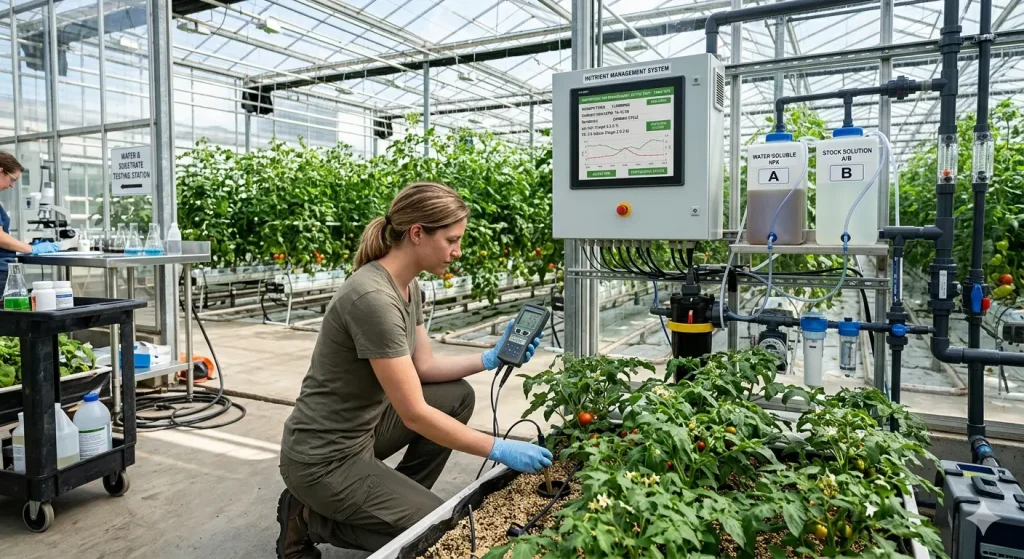
Most commercial greenhouse operations depend on fertigation because it allows nutrients to be delivered in frequent, controlled doses. This method improves timing and placement, but only if the fertilizer dissolves fully, remains stable in solution, and moves cleanly through the system.
For this reason, water-soluble NPK products are usually the preferred choice in protected cultivation. They reduce the risk of clogging, allow accurate injector performance, and make it easier to maintain a consistent nutrient recipe. Low-quality material can create sediment, compatibility issues, or uneven feeding, all of which increase labor and reduce crop performance.
Clean raw materials and disciplined manufacturing standards make a measurable difference here. Commercial buyers are not just sourcing nutrients. They are sourcing reliability in storage, mixing, transport, and daily application. For distributors and greenhouse operators managing large volumes, consistency from batch to batch is a serious operational advantage.
What can go wrong with greenhouse NPK programs
The biggest mistakes are usually not dramatic. They are cumulative. Slightly excessive nitrogen over several weeks. Potassium that remains below crop demand during fruit load. A formula selected without considering irrigation water bicarbonates or calcium and magnesium interactions. These issues can reduce output quietly before they become visible in the crop. Even with well-designed programs, nutrient performance can vary depending on water quality, substrate composition, and environmental conditions. Regular monitoring through EC, pH, and tissue analysis remains essential.
Another common problem is using the same nutritional program year-round. Greenhouse demand changes with light levels, temperature, humidity, and crop speed. Winter production often requires a different feeding strategy than high-radiation summer cycles. The nutrient ratio may still be suitable on paper, but the concentration, frequency, or uptake pattern may no longer be aligned with plant demand.
There is also a supply-side risk. A greenhouse nutrition program is only as reliable as the product behind it. Inconsistent particle size, variable solubility, contamination, or unstable supply can disrupt operations quickly. For professional buyers, fertilizer sourcing should be evaluated not only by nutrient content but also by manufacturing quality, logistics capability, and long-term availability.
Best practices for greenhouse NPK management
- Monitor EC and pH regularly to maintain nutrient balance
- Adjust NPK ratios according to crop growth stage
- Avoid fixed feeding programs throughout the entire cycle
- Use fully water-soluble fertilizers for fertigation systems
- Test irrigation water and substrate composition periodically
How commercial buyers should evaluate NPK fertilizer for greenhouse crops
For procurement managers, distributors, and large-scale growers, product selection should go beyond the guaranteed analysis. Solubility, chloride content, purity, compatibility with fertigation systems, and formulation consistency all affect field performance. Packaging integrity, export readiness, and supply continuity also matter when production schedules are tight and crop interruptions are costly.
A supplier with direct manufacturing capability is typically better positioned to control these variables than a business that only trades finished goods. That matters when you need repeatable quality at scale, whether the goal is supporting protected vegetables, berries, ornamentals, or nursery crops across multiple markets. As a manufacturer-focused company, FERTIZER develops water-soluble NPK formulations specifically for fertigation systems, ensuring consistent solubility, purity, and batch stability across large-scale greenhouse operations.
From a commercial standpoint, the strongest NPK program is not necessarily the most complex one. It is the one that delivers predictable plant response, stable operational performance, and efficient nutrient use without creating unnecessary corrections later in the cycle.
Building a stronger greenhouse nutrition strategy
A successful greenhouse feeding program usually starts with a clear crop-stage plan, then adjusts based on analysis and plant response. That means matching the NPK ratio to the crop objective, using water-soluble formulations suited for the irrigation system, and avoiding the habit of feeding by routine alone. Precision matters more in protected cultivation because the margin for error is smaller and the value of each production block is higher.
Greenhouse crops reward disciplined nutrition management. When NPK ratios are aligned with root development, canopy balance, flowering, and fruit load, the result is not just better plant health. It is stronger marketable yield, more uniform output, and better return on every controlled input. The right fertilizer program should support that result with the same consistency your operation expects from the greenhouse itself.
The best time to improve a greenhouse nutrition program is before minor inefficiencies become expensive habits.
Frequently Asked Questions (FAQ)
There is no single ideal ratio. Early stages benefit from balanced or phosphorus-supported formulas, while fruiting stages typically require higher potassium levels to improve quality and yield.
Yes, but only for specific stages. While 20-20-20 is a versatile formula, relying on it throughout the entire cycle may limit performance, especially during flowering and fruiting phases.
In most systems, nutrients are applied through fertigation in frequent, low doses. The exact frequency depends on crop type, substrate, and irrigation strategy.
Potassium supports fruit development, firmness, color, and stress tolerance. It becomes especially important during flowering and fruiting stages.
Imbalances can lead to excessive vegetative growth, poor fruit set, weak roots, reduced quality, and lower marketable yield.